Mrs Vandebilt und ich (1/5)
„When your light is on the blink,
you never think of worrying
What’s the use of worrying?“(Paul McCartney)
Es war zwischen den Jahren, und es ist ein wenig verrückt und unergründlich traurig gewesen. Das Abitur hatte ich schon ein Jahr in der Tasche, und in einer sehr warmen Frühlingswoche fuhr ein dafür komplett ungeeignetes Trio zur holländischen Nordsee. Ich muss mich ein wenig sammeln, beim Nacherzählen, und wohl den Teil mit „Eric Rohmer ab 18“ weglassen. Gestern sah ich eine Zeichnung von Walla (der Name ist erfunden) im Netz. Wenn Walla das hier lesen würde, hätte ich wahrscheinlich gleich einen säuerlichen Anruf zu erwarten. Ich glaube, wir waren uns von Anfang an nicht sonderlich sympathisch, und heiss war ich auf Walla auch nicht. Und umgekehrt war es genauso. Und dann war da noch Lore (der Name ist natürlich auch erfunden), und das machte die Reise rückblickend noch um einiges komplizierter. Die Blonde und die Brünette – und die von mir damals Angehimmelte sass in ihrem Dachgeschoss, und hatte mir nur einmal fünf Minuten Knutschen gestattet und sich von einem Idioten, der muskulös den Frauenkenner raushängen liess, und manches Girl mit einer erstklassigen Raubpressung von „Leonard Cohen live in Essen“ zu einem Kaffee in seine vier Wände gelotst hatte, durchvögeln lassen. Das war hart genug für mich zerfliessenden Romantiker. Und nun fuhr ich mit zwei leicht anstrengenden Mädels Richtung Scheveningen, für mindestens eine Woche. Das Beste an der Hinfahrt waren die zwei Platten von J. J. Cale, die als Kassette im Käfer liefen, wieder und wieder, „Naturally“ und „Really“, oder eine von den beiden. Wir waren anfangs schon guter Laune, von wegen Urlaubsstimmung, Holland, das Meer. „Wir sind Hippies!“ Knapp eine Woche später sass ich einer trostlos leeren Disco in Scheveningen, und ich erinnere mich daran, dass „You‘re So Vain“ und „Band On The Run“ zu hören waren. Ich trank zwei Bier, sah mein langes braunes Haar im Spiegel, und dachte an die sieben vergangenen Tage. Ein Highlight war, dass ich am Strand einen heissen Kakao mit Sahne bestellt hatte und dann feststellte, dass das, was sich Sahne nannte, hart und verklumpt war. Vor einem keinswegs amüsierten Publikum spuckte ich das schreckliche Zeug in einem Schwall aus. Es war also ein Frühjahrsabend in einer Disco, nichts passierte, ich träumte so vor mich hin, und dann passierte es doch, das grosse Abenteuer, wenn man das so nennen will.
Oregon Treffpunkt Jazz 1990
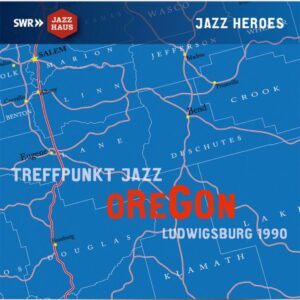
Oregon’s newly released live album, Treffpunkt Jazz, Oregon Ludwigsburg 1990, is the only official Oregon live album that features Trilok Gurtu on tablas and percussion. Like many Oregon fans, I am a diehard appreciator of the early Oregon albums with Colin Walcott on percussion. Nonetheless, I also have a great appreciation for the work that Trilok did during his time with the band. Gurtu is a powerhouse. His tabla playing is hard to beat, although he is perhaps not quite the master of colors that Colin was, who was a poet in his intuitive sensibilities; he always seem to know just the right thing to play at the right moment. That being said, Trilok is no slouch on his extended percussion setup.
The repertoire on this album ranges from the early Silence of a Candle, through classic Oregon standbys such as the Jim Pepper peyote chant inspired Wichi-Tai-To (first recorded on Winter Light and several times afterwards,) and June Bug (Roots in the Sky,) and extends through the album 45th Parallel, with the marvelous Towner compositions Les Douzilles and Hand in Hand. My favorite performance thus far from this sprawling two CD set is Yet to Be, originally recorded on Northwest Passage – it’s a joyful romp, performed with great aplomb and enthusiasm. Also, Waterwheel (Out of the Woods,) is superbly presented here. Tempos on both of these tunes are brisk, and the performances are inspired and adventurous, yet tight and precise.
Note, this album is from 1990 and thus, Ralph Towner’s fascination with synthesizers is on full display here. Some people objected to the addition of electronic textures to the band’s signature acoustic sound. This may put off the fans of earlier Oregon albums. However, in this listener’s opinion, for the most part, the synths are deployed tastefully and generally do not dominate, nor do they detract.
I feel this album is very representative of the sound of the band in the early 90s, and rather than just being an interesting oddity, primarily targeting Oregon diehards desperate for anything new from the band, I consider it a wonderful addition to the Oregon catalog and an essential gift to any fan.
The recording quality here is nothing short of stellar. In my opinion, this is one of the best Oregon live albums ever released. Perhaps only the earlier In Concert comes close in terms of overall performance and audio fidelity, although I honestly prefer the sound of this recording over any of their previous live releases.
„April Revelations“
Unsere „Enthüllungen“ für den Monat April liegen nun vor. Von Ingos Reise durch diverse, von Charles Lloyd befeuerte, Jazzhorizonte, über Martinas „in depth“-Besprechung von Daniel Clowes‘ jüngster „graphic novel“, bis hin zu Jan R.‘s Zeitreise zu einem Pariser Konzert der Gruppe Can anno 1973. Wir erinnern in diesen „seitlichen“ Kolumnen gerne auch an alte Texte, alte Interviews, alte Hüte und Schätze, und versuchen das möglichst vielstimmig anzulegen. Wer so einen Monat voller „revelations“ mal im Alleingang aufbereiten möchte – einfach melden! So bietet ein älteres Gedicht von Rick Holland die Gelegenheit, an seine diverse Zusammenarbeiten mit Brian Eno zu erinnern. Es gibt auch Neues von Rick – dazu im April dann mehr.
Es wird an den Klassiker „L.A. Confidential“ erinnert (in einem Atemzug mit dem mich stets auf Neue begeisternden Western „Silverado“, den ich seit er in die Kinos kam, gewiss fünfmal sah), an die Doku „The Greatest Night In Pop“ (Netflix) – in der Abteilung „Binge“ nicht ganz sachgerecht untergebracht. Wer dort eine neue tolle Serie vorstellen möchte, darf jederzeit meinen Binge-Text ersetzen, der ja sowieso im Blog Diary vorliegt. Es gab ja ein paar Serien, die einigen von uns zuletzt Deepness, Freude, Flow und Gänsehaut in unterschiedlichen Kombinationen bereiten konnten, ob True Detective‘s „Night Country“ oder die zwei Staffeln von „The Bear“, whatever…

Als ich Jans „Liebeserklärung an ein 50 Jahre altes Album“ las, ist mir nochmal sehr bewusst geworden, wie anders man ab einem gewissen Alter solche Alben hört, die zum „Soundtrack unseres Lebens“ geworden sind. Sie dann immer noch als Abenteuer zu erleben, anti-nostalgisch, nicht rein historisch, ist nicht so leicht und hat einen besonderen Reiz. Witzig wird es, wenn man feststellt, so ein halbes Jahrhundert altes Teil komplett verpasst zu haben, und das ist mir so ergangen mit der Wiederveröffentlichung von „Band On The Run“ (die Edition mit den zwei CDs ; das Album kam raus am 5. Dezember 1973). Zwar kannte ich natürlich „Jet“ und Titelsong, aber dass die ganze Scheibe mich so von vorne bis hinten packt (ich meine so richtig packt, unabhängig von der unglaublichen Entstehungsgeschichte des Werkes, über die man zuletzt viel lesen konnte), hätte ich nicht gedacht.
Und mit ist dabei eine Reise mit zwei Mädels eingefallen, nach Scheveningen, 1974, im Frühling, in meinem ersten Käfer, und ich sehe die Pommesbude vor mir, aus der, aus einem schräpigen Transistorradio, „Jet“ ertönte, und was in der Disco passierte, und wie wir uns Charles Bukowski vorlasen. Das ist eine leicht melancholische Story, mit verpasster Magie, dezenter Tragikomik, anstrengender Sprachlosigkeit, dass man daraus auch einen Eric Rohmer Film (aber ab 18!) hätte machen können, mit „real life camera“ – „dogma style“. Die Story wird wohl erzählt werden, demnächst. Und, übrigens, als ich unlängst, wieder und wieder und immer im Dunklen, und laut sowieso, „Band On The Run“ auflegte, las ich auch von einer anderen Schallplatte von Paul und Linda (vielgerühmt), und die ich, einmal mehr, überhaupt nicht kenne, ausser vom Namen und Cover, „Ram“. Das Teil wurde vor Jahren neu remastert in den Abbey Road Studios, und irgendwann nach den JazzFacts vom 4. April (Deutschlandfunk, 21.05 Uhr), werde ich „Ram“ in aller Ruhe hören… for the first time in my life. The first cut is the deepest.
This thing with „spirituality“
As time goes by … „Soundtrack“ war meine erste Platte von Charles Lloyd, noch in Schulzeiten. Womit ich nicht sagen will, was für „smarte greenhorns“ einige von uns damals waren. Vielmehr ist es eine Tatsache, dass die Musik, die Menschen in verdammt jungen Jahren der Unerfahrenheit erreicht, oft etwas „Tiefes“ in Schwingung versetzt, mit lang anhaltenden Nachwirkungen. (Der grosse Philosoph Immanuel Kant irrte ganz und gar, als er die Welt der Musik als „oberflächliche Gemütsreizung“ abkanzelte.) Charles Lloyds Jazz war lässig, entspannt, auf fröhliche Weise exstatisch (im Hippieslang hiess das „groovy“), und voller Klanghorizonte! Those were the days, my friend! Und trotzdem kein Grund, das alles in pure Nostalgie zu verwandeln. Die JazzFacts Im Deutschlandfunk (4. April, 21.05 Uhr) schlagen so manchen Bogen zwischen der Musik von damals und der Gegenwart. Nicht nur wegen der Wiederbelebung des Labels Impulse Records. Nicht nur, weil auf ECM immer noch fantastische Solopianoalben erscheinen (was die „nächtlichen“ Sphären von Fred Herschs „Silent, Listening“ angeht, fühle ich mich an Paul Bleys „Open, To Love“ erinnert).
Kahil El‘ Zabar‘s Ethnic Heritage Ensemble: Open Me, …
Fred Hersch: Silent, Listening
Beitrag 1 von Michael Rüsenberg („Destination Unknown“)
A. Kalma, J. Chiu, M.S. Honer: The Closest Thing To Silence
Live At Carnegie Hall (1971) – Impulse (A. Coltrane)
Shabaka: Perceive Its Beauty, Acknowledge Its Grace
Beitrag 2 von Karl Lippegaus (Jason Weiss: Listenings)
Fred Hersch: Silent, Listening
Charles Lloyd: The Sky Will Be There TomorrowGaza ist ein Friedhof
Es gibt überhaupt keinen Grund, Künstlern Antisemitismus und Israelhass zu unterstellen, die gegen die schweren Kriegsverbrechen der Israeli in Gaza protestieren. Ob Brian Eno, Julia Holter, Susan Sarandon, Jonathan Glazer. Um nur ein paar zu nennen. 2/3 der unschuldigen Opfer, zigtausende (!), sind Kinder und Frauen. Wer das mit unvermeidlichen Kollateralschäden rechtfertigt, verrät nur seinen eigenen Menschen verachtenden Zynismus Widerlich das rücksichtslose Töten der israelischen Kriegsführung, so widerlich wie das entsetzliche Gemetzel der Hamas. Ich bin erschüttert von dem fortgesetztem Waffentransport nach Israel aus Deutschland. Gaza war ein Gefängnis, jetzt ist Gaza ein Friedhof. Eine Zwei-Staaten-Lösung ist die einzige produktive Lösung, Netanjahu und seine Rachepolitik versucht das mit aller mörderischen Macht zu verhindern.

There is absolutely no reason to accuse artists of anti-Semitism and hatred of Israel who protest against the serious war crimes committed by the Israelis in Gaza. Whether Brian Eno, Julia Holter, Susan Sarandon or Jonathan Glazer. Just to name a few. 2/3 of the innocent victims, tens of thousands (!), are children and women. Those who justify this with unavoidable collateral damage only betray their own contemptuous cynicism. Disgusting the ruthless killing of Israeli warfare, as disgusting as the horrific carnage of Hamas. I am shocked by the continued transport of weapons to Israel from Germany. Gaza was a prison, now Gaza is a cemetery. The two states solution is the only productive solution, Netanyahu and his revenge politics are trying to prevent that with all their murderous might.
(Dear Lukas, please send this to Julia Holter)
(Am 19. März sind in Utrecht Tausende Kinderschuhe aufgestellt worden, um auf die getöteten Kinder im Gazastreifen aufmerksam zu machen.)
Fleeting thoughts on Julia Holter songs (2)
Olaf and I were talking bass a bit when changing mails about this very special work. As Tom Pikarski writes in Exclaim: „When Devin Hoff’s fretless bass enters, it does so like a layer of molasses; rich, sticky and sweet. Hoff’s contributions are an essential component of the record, calling to mind the vital role that bass plays in the music of Holter forebearers like Kate Bush or Joni Mitchell. (…) Perhaps the greatest feat of Something in the Room She Moves is that, while there are plenty of organic instruments all over these recordings, it’s the synthesizer playing and sound design that lend the record its characteristic lived-in, sinewy and roving lifeforce.“ And now our fleeting notes. On side B. This will definitely be a one time experiment. We were not happy with splicing the whole work into single pieces. We always had to imagine its flow instead of experiencing it. Our deepest listening still lies ahead, I think. That said, don‘t take our words too serious, smoke them in a pipe, put the record on – and float downstream!
Spinning
Olaf: A steady beat is the ground from which strange textures blossom – moog, bass, voices, noises, delays, only a few wind instruments for a change. Everything disintegrates towards the end, the textures wither away, the the song tumbles and falls apart. (I repeat myself but I really like what the bass player does, very melodic and sensitive playing.)
Michael: So here we are, at the beginning of side B. The perfect place to let the rhythm in… and, yes, while it nearly all dissoves into air at the very end, another kind of voice takes the lead: calm clear, focussed. The calmness after the dance. The track grabs me more and more. This album seems to be the classic grower.
Ocean
Michael: The ambient piece, the oceanic piece. Julia is smart: instead of delivering a purely peaceful landscape, she let‘s the uncanny in sideways, after a while. You never know, oceanwise… it ends on a tranquil note though.
Olaf: Nothing to add. „Ocean“ is another proof of Julia Holter‘s versatility; unique music, that fits perfectly at this moment. And it wouldn‘t feel out of place on any state of the art ambient album. This snapshot of the ocean was made in the evening, which brings us to the next song.
Evening Mood
Olaf: A counterpart to „These Morning“. Being tired after a long day, its events appear like a mild vortex on the threshold of sleep. The voice binds the musial elements of this vortex into a song. Again: lovely singing, beautiful bass playing – and a dash of Harmonia towards the end.
Michael: Really, Harmonia? Have to listen again with your ears. The calmness, and the apparitions of the day receding… but after initial moments of letting loose and introspection , a lingering irresisitibe melody blows new life into the singer‘s voice and leads us through the evening‘s offerings between the wistful and the dreamlike. All in perfect union with heightened awareness. (From start on, listening to this album requires a very relaxed state of mind. My trick: darkness and a candle.)
Talking To The Whisper
Michael: Maybe the most complex song… you never know where the journey of a single track goes, except sideways, most of the time: in the second half Chris Speed‘s saxophone conjures a dark fantasialand full of wonder, a sense of danger follows, then: boiling point.
Olaf: It really is a complex song, constantly on the verge of ending, laying false trails. At the same time I find it one of the most emotionally engaging songs on this album. There is this middle section that totally gets me: „Let me light, let me throw light/ On your path, little one / Leave me time to stop and say / Love can be / Shattering“.
Who Brings Me
Olaf: A lullabye to close the album. Major themes reoccur: sleep („As I fall asleep“) water, sound („And the eyes of the water tide / Scanning blind with just the sound to guide“), love („You, my love waking up my every day“). Sparse instrumentation, the string instrument and the overall atmsophere remind me of the Velvet Underground – gorgeous and uncanny.
Michael: This song has to happen at the end. Things calm down. But not like all is good and pancakes. Unsettling dream images pop up… („Fading gusts of luck change my breath“) … and I ask myself: what has that all been about (ready for a second, for sure, deeper journey)… There‘s an interesting balance on this whole album between, well, apparitions from nowhere (dream life), clear structures (for a while), and things / sounds falling apart.
Can: Live in Paris 1973
Nach gleichartigen Veröffentlichungen aus Stuttgart, Brighton und Cuxhaven mit Can in Viererbesetzung, die aus der zweiten Hälfte der 1970er Jahre stammen, kommt hier nun ein Livemitschnitt von 1973 — zu fünft, denn dies war einer von Damo Suzukis letzten Auftritten mit Can.
Wie schon die anderen drei Alben basiert auch Live in Paris 1973 auf ursprünglich illegal mitgeschnittenen Bootlegs, die von Fans zur Verfügung gestellt und von Irmin Schmidt und René Tinner sorgfältig restauriert und optimiert wurden. Die Tonqualität ist verblüffend gut; zu bemängeln wäre höchstens, dass die Aufnahmen in mono sind, aber das kann angesichts ihrer Quellen nicht anders sein. Man vergisst das beim Hören sehr schnell.
Wenn es um Liveaufnahmen von Can geht, ist oft Vorsicht angesagt. Denn über weite Strecken wurde auf der Bühne improvisiert, und bis die Band ihren Stiefel gefunden hatte, das konnte dauern. Wenn sie ihn dann aber hatte, dann konnte pure Magie passieren. Und das ist auf dieser Platte eingefangen.
Gleich der erste Track mit einer Spieldauer von 36 Minuten ist ein Erlebnis. Aus dem, was die fünf hier fast beiläufig präsentieren, hätten andere Bands drei komplette LPs gemacht, bei Can dienen die Ideen einfach nur dazu, weiterentwickelt zu werden. Es ist wie Fahrradfahren: Wer stehenbleibt, fällt um. Die Magie Cans beruht nicht zuletzt darauf, dass jede noch so verrückt scheinende Idee, jede Phrase, jede Floskel, die einem der Musiker einfällt, mit Sicherheit von einem der anderen aufgenommen und weitergesponnen wird. Immer konnte sich jeder darauf verlassen, dass keiner der anderen etwa „He, was soll denn das jetzt?“ sagen würde, sondern der Ball wurde weitergekickt. Dabei mussten keineswegs immer alle gleichzeitig spielen; Zuhören und Abwarten konnte genauso ein Beitrag zum Gesamtergebnis sein. Dieser Track Eins zeigt das mustergültig. Michael Karoli an der Gitarre hört man hier mit einem Höhenflug, wie man ihn selbst bei ihm selten erlebt hat.
Die anderen vier Tracks sind kürzer und — was bei Can-Konzerten keineswegs selbstverständlich war — beruhen auf sofort erkennbaren Tracks der Studioalben bzw. der B-Seite der „Spoon“-Single; „Shikako Maru Ten“ hieß das Stück, eine ausgedehnte Impro-Version von „Spoon“ gibt es dann als Track Drei. Den Ursprung des Tracks Vier kann ich nicht unterbringen, obwohl er mir vertraut vorkommt; der auf die Dauer ein wenig zerfahren wirkende Track Fünf hat dann eindeutig „Vitamin C“ zu Grundlage. Dass deser Track nach 13 Minuten plötzlich abreißt, zeigt die Herkunft des Mitschnitts: Offenkundig war da bei dem bootleggenden Fan die Cassette zu Ende. Da hätte man vielleicht auch ein Fadeout einsetzen können, aber man hat sich dafür entschieden, den Hörer aus der Kurve fliegen zu lassen. Hat auch seinen Reiz.
Von den bisher erschienenen Alben der „Live“-Reihe ist Live in Paris 1973 ganz sicher das stärkste. Einmal mehr wird wieder deutlich, weshalb Can musikalisch so gut wie unangreifbar war.

„Verzierungen, Geheimnisse, Überraschungen“
„Hören Sie sich dieses Album an, wenn Sie aus dem Fenster schauen, hoffentlich mit Blick auf eine frühe Blüte. Direkt über den Dächern steht ein Baum mit Blüten, die so rosa sind wie Himalaya-Salz. Wenn ich mir das anhöre, kann ich nicht wegschauen. Etwas hindert mich daran, mich zu bewegen. Ich kann mich nur noch der Musik hingeben. Meine ganze Aufmerksamkeit gilt dem Warten auf den nächsten Leckerbissen: den Verzierungen, den Geheimnissen und Überraschungen, die Julia Holter bietet.Something in the Room She Moves ist sicherlich ein intimer Hörgenuss. Es hat eine Lockerheit, die warme Untertöne hervorruft. Aber jetzt möchte ich es auf einem massiven Soundsystem hören. Auf dem Boden liegend, inmitten einer modernen Kunstgalerie oder einem epischen Festivalzelt – irgendwo, wo ich die klanglichen Erkundungen spüren kann“
So beginnt Laura Cannells längere Besprechung, in The Quietus, von Julia Holter neuem Album, das morgen in den Handel kommt. Olaf und Michael werden ihre Impressionen von Seite 2 der Vinylversion in Kürze folgen lassen. Für den ersten Teil muss man nur wenige Tage zurückscrollen . Michaels Fragen liegen Julia vor, vielleicht kommt sie noch in die Gänge. It never rains in Sourhern California. Sie hat derzeit viele andere Dinge um die Ohren, und wenn es nicht klappt, ist niemand böse drum.
„The Ship“ – a review and a story
PROLOGUE
A late summer’s night in the distant future. If there is still life, there will still be radio stations! In this case a rebuilt light tower on the lonesome crowded American West Coast, not far from San Diego. In her popular show „Off-Centre Adventures Thru Sound“, DJ Mireia Moreorless – intelligent of expression, high of heel, intoxicatingly nonchalant of superiority – takes the listener on a stroll through British music history between 1975 and 2025.
In the space of five hours, she plays a lot of classics. A short look at her playlist reveals, amongst other gems:
Talk Talk’s „Laughing Stock“
Kate Bush‘s „Aerial“
John Cale’s „Paris 1919“
PJ Harvey’s „I Inside The Old Year Dying“
Robert Wyatt’s „Cuckooland“
Gavin Bryars‘ „The Sinking of the Titanic“
Beth Gibbons‘ „Lives Outgrown“
Brian Eno’s „The Ship“
National Jazz Trio of Scotland: Standards, Vol. IVThe Ship got its airplay in the middle of the night, people called that record still „spooky“ in 2135, especially „Fickle Sun (i)“. It was the first record she’d ever heard by Brian Eno; her grandfather played it one night, on a soundfile with Gustav Mahler on it. As well as The Dead Kennedys, Squarepusher, Nick Drake, John Lennon, Hamish Imlach, Ivor Cutler, Fugazi, Arvo Pärt, and some East India Youth tracks from his Mojo „album of the year 2020“.
SETTING OF THE SCENE
Ah … yes – the opening scene of „The Ship“. Gently does it. Nothing much happens, an oceanic view, „Music for Dead Harbours“, no humans involved, no figures in the landscape. Not yet. Things slowly unfold after minutes – the here and now will maintain the ineluctible quality of the long, faraway gone throughout.
Life – what’s left of it – slowly awakens. The Ship drifts further off, with Brian Eno’s deep voice, hitting the low C, announcing what’s going on, delivering a Sisyphus / Lazarus job giving its best to stand the test of stoicism. This is the rise and the fall and the wash and the fade. The ebb and the flow. Sooner or later other voices will gather around within earshot – via the ether, megahertz radio chatter: ghost voices, disembodied intonations reassuring themselves they are alive. Kicking.
All continuity fractures: a postmodern parody of a Greek choir. A crack-up, a falling apart, in comes „Fickle Sun (i)“, another poorly dimmed world …
„and so the dismal work is done‘
‚the empty eyes, the end begun‘
‚there’s no-one rowing anymore …
… abandoned far from any shore.“
The tone changes from the first moment on „Fickle Sun (i). A tour-de-force without parallel among Eno’s works. These 17 minutes observe everything turn to dust and rubble. If it isn’t an unconscious channeling, Eno’s full-bodied singing during the opening passage suggests some serious source studies of sea shanties and maritime tavern songs from Northumbria down to East Anglia. Songs from similarly desperate, earthier times.
Eno’s voice with all its treatments is a real treat. Here the passionately executed lines have their own colour and discrete shade and shape – at one point like distant cousins of The Unthanks – specialists in contemporary versions of ancient country and sea folk with its perennial cycles of love, hate and disaster.
Ahh, sea songs.
– Worse things happen at sea, Vladimir.
– That is true. But you do know where we are, Estragon, don’t you? Yes?
– No, I mean, well, … not really. Where are we?
– On the ocean, Estragon. Floating on the ocean. Can’t you hear the waves lapping lustily? Nor hear the seagulls squawk-squawking violent regret that no sardines shall be srown into ze sea?
– Yes, Vladimir. Well actually, no. I thought the racket was just louts! But the floor is rolling, and, well, we are standing on what looks like a fo’c’sle.
– Right.
– Right …
– Do you remember the Gospels?
– I remember the maps of the Holy Land.
A WIDESCREEN VOID
The sea is a recurring theme in Eno’s oeuvre: full of yearning in ‚Julie and I‘, rich in humour in ‚Backwater‘, vast and immense in ‚Dunwich Beach, Autumn 1960‘. Languid, faintly heartbroken, green and luminous in ‚Becalmed‘. The element of surrender has always been the common thread, but until now this topic hasn’t been realised with such bleakness. A starless, bible-black frieze. A widescreen void.
This work suggests the everyday darkness of wartime. And the liminal space where every last breath is a long slowmotion leap onwards toward permanent relief from pain and trauma. And in this liminal space the cup is not broken but is so near to broken that neither ‚broken‘ nor ‚unbroken‘ fully applies. A juncture where language for now, has stopped working, its semantic flow interrupted.
Out of nowhere, in this album of constant losses and sudden appearances, an electric guitar suddenly howls painfully before decaying, at length, into oblivion. This old instrument is an unexpected guest here (especially with its history and associations. Goosebumps and shock value guaranteed. Christian Fennesz couldn’t have done it better here. Nor Edgard Varèse).
Then, into this overwhelming symphonic microcosmos comes the Scott Walker moment – fifty or more more hot shots of brass, da Daa DAAA. Highly effective in its apparent simplicity (and, yes, phonetic approximations are ridiculous when you’re trying to describe the way your breath is being taken away here). Think of it as an Ernst Jandl anti-war poem: ta Taaa TAAA. Again&again&again&AGAIN. Crescendo time. Shoot me to the end of night.
After this (the track’s climax – in fact the climax of the whole album) the song turns into a highly sensual study of decay, or, more precisely, a mourning: ‚All the boys are going down / Falling over to the ground‘. If a textbook ever covers the parallels between the works of Gustav Mahler and contemporary music between 1970 and 2020, then ‚Fickle Sun (i)‘ will have an entire chapter devoted to it.
ILLUSION OF CONTROL
Not that we know anything of Eno having a thing for the Austrian composer, but the point’s simple – while the likes of Wagner liked to pour on emotionalism and actorly heroics, Mahler lets all the pathos trickle away, the icebergs of grand musical gestures are always being melted down to the textures of wastelands – lost illusions of control.
So does Eno in the closing moments here. Single vocal lines linger. Mumblings of the dying (‚ … when I was a young soldier … ‚). But no-one’s seeing light on the other side, or angels pulsating in the corners of the frame. There’s something in the absence of dancing photons in the peripheral vision. Probably best not try to describe in detail what goes on in the final passage, where the echo chamber of voices takes over – cos it could easily sound like a lysergic acid-submerged moment out of a Philip K. Dick-novel.
Over the waterfall. That’s a simple way of putting it.
THE WEB HAD DIED YESTERDAY
„Fickle Sun (ii)“ is a Speaker’s Corner surrounded by a sea of turmoil, disturbance, entropy, weird beauty and unrelenting loss. After two long compositions dealing with the cost of hubris and the solitude of dying, when this track appears it’s like an aftershock. All quiet, but the ground still shakes, and the album’s central topics bounce around like semantic UFOs in the mind’s sky: „… The hour is thin / Trafalgar Square is calm / Birds and cold black dark / The final famine of a wicked sun …“
Spoken by actor Peter Serafinowicz in a voice that defies drama and distance, and accompanied by a delicate, minimal piano figure that knows where to hold breath, the piece sets the listener’s mind afloat and wondering – with all its verses, quotes and lines derived from the „Markov Chain Generator“: „And the web that died yesterday / I was a hard copy version / I turned my eyes directly to hate“
Using a mix of computer-generated chance operations and last refinements of a human being, this „man-machine“ is the perfect link between what came before, and what will come after. It’s a clearing of thoughts without leading those thoughts in a certain direction. Sharp and short as this track appears, it creates a properly surreal mental space: „Tired of what the world has yet brought forth / With the women wavin‘ at war“.
ROLLING ON THE GROUND
The whole beast is a contemporary lamento of the highest order and ends with a jukebox-song you possibly can’t resist to get lost in. Sounds strange? It does. Brian Eno often looks for a resolution, a passage of release, on the final tracks of his works and has done so since HERE COME THE WARM JETS and TAKING TIGER MOUNTAIN (BY STRATEGY).
Not being a rule he hasn’t broken from time to time (think of ANOTHER DAY’S ON EARTH’s frightening finale „Bonebomb“, a favourite track of David Bowie), Eno offers a state of momentary bliss with his version of the old Velvet Underground-track „I’m Set Free“. Bleak existenzialism of the original turns into a gospel-tinged, future „evergreen“, with swelling strings and singing of the stone melting kind.
After the long and immersive journey this masterpiece (yes, that it is!) has been inviting you to before (a hell of a ride, executed with passion, stoicism and sadness in equal parts, sonically adventurous throughout), one probably is easy prey for this hymn on its way to rock bottom or heaven’s saving grace, until the very last, dying note – not overhearing the undercurrent of melancolia:
„ … Now I’m set free /
I’m set free /
I’m set free to find a new illusion … „
EPILOGUE
The Feint Gunpowder Blue
The feint gunpowder blue of early morning light reflects in her pupils as DJ Mireia Moreorless breathes in deeply and exhales. She’s closing her marathon of British old time avant-greats with Robert Wyatt’s ‚Sea Song‘ and a twisted tale about a big wave by Ivor Cutler. These nights at the lighthouse radio station are her preferred mode of time travel – but now, under a postmodern California sky, she’s just happy to see her cyborg lover Kasumi waiting at the entrance area in a carmesin red Austin Mini Hydrogen. A soft kiss, and Kasumi lets herself smile broadly at the vision in the passenger seat.
Au Pont de Neuilly
Let’s pause for a short while here, since you may possibly want a bit more about Mireia. If she’s a type, she’s the woman you sometimes see on the Paris Metro. She doesn’t see you. She’s probably on her way to Pont de Neuilly via an interchange to Line 1. Idiots stare at her. But you don’t, and don’t need to, because her nonchalant superiority shoots like moonbeams in a billion directions, and those moonbeams even in peripheral vision are in themselves a cosmic blessing.
Time Itself Could Escape
The secret is simple – she never realised the world’s pedestal for her. Her dad was watchmaker who invented a tourbillon that could counter the effects of gravity so well that time itself could escape its strictures within the space-time continuum. Her mum was a nurse. To her, being a DJ is a humble occupation.
Bullets of Adulation
People fire bullets of adulation her way, all the time. And every single time, they miss. But one day, soon, she will meet her match. And life will move haltingly in the light, for a second, while in another hemisphere stars will fall across the sky in 1000s at random, speeding along brief vectors from their origin in a question mark to their destinies in dust and the nothingness that is nowhere and is endless.
Night Flights Over Los Angeles
She first met Kasumi in a supermarket in Carmel, sometime during a week-long early autumn surfing trip. It didn’t take long to register. They have so many interests in common – leftfield music, jukebox culture, exotic car travels, French cuisine, tantric sex, helicopter night flights over Los Angeles, ghosts, rivers, standing stones, Bakerloo Line moquette, Highland castles, Curly, Larry, Moe, Shemp, lucid dreams, tea, clouds, rain.
Slowcommotion Wilderness
The night’s programme of music has been immersive but there’s no suggestion of fatigue. Mireia’s senses are still in fifth gear. At home, in their tiny beach house, they make love to one another, today in their „slowcommotion wilderness“ mode that doesn’t involve much movement. Afterwards, Mireia falls asleep almost immediately, and when she wakes up four hours later, she remembers a dream with a wooden jukebox and her grandfaher telling her about when there had been a jukebox revival in the early 21st century.
Coq au Vin
She opens her eyes, and sees Kasumi preparing coq au vin for the evening. After a short swim in the ocean, she moves through the living room and puts a vinyl record on their record player, an ancient „VPI Prime Forward iii“ designed by machines in Japan and manufactured by other machines in New Jersey in 2055. She puts on one of her evergreen albums from the era of last night’s journeys through old Britannia, Brian Eno’s „Oblique Collection of Antique Jukebox Adventures“, a big seller in 2025.
Irony of Fate
That guy who once coined the term ambient music, had his biggest commercial success (irony of fate) with a collection of heartwrenching, nevertheless strange versions of classic and bizarre pop songs. Eno once had an a capella group (just for the fun of singing), and one of the rules was never to publish any of the things they were doing in the comfortable space of his studio. But then, he gave it a second thought.
Django Rheinhardt
Who covers their covers in glory? Johnny Cash has done it (and brilliantly so in his last years), Bryan Ferry has done it, Patti Smith has done it, Cat Power has done it, Willie Nelson has done it. Kasumi won’t. She improvises lyrics to crackly bakelite Django Rheinhardt favourites like „Minor Swing“ and „The World Is Waiting For The Sunrise“, but only sings them unaccompanied, in the shower.
Eno listed songs he liked very much, and focussed on those where he was confident enough to add another unknown layer. And of course the final choice had to suit his way of (very British) singing with slim vocals, and no big paint brush.
801
Mireia looked on the tracklist while the first song was playing: a dark earcandy version of Ray Davies‘ „Rainy Day In June“ followed by a new version of The Beatles‘ „Tomorrow Never Knows“, Eno himself had once sung on Phil Manzanera’s „801 Live“. A really special collection, including two Everly Brothers classics, The New Vaudeville Band’s „Winchester Cathedral“, Scott Walker’s „It’s Raining Today“, Tom Waits‘ spoken-word piece „What’s He Building“, and The Doors‘ „People Are Strange“.
Denouement
When the Doors song finally appeared, Kasumi appeared. She put her arms around Mireia, and they both sang along with Eno’s singing:
„People are strange when you’re a stranger
Faces look ugly when you’re alone
Women seem wicked when you’re unwanted
Streets are uneven, when you’re down
When you’re strange, faces come out of the rain
When you’re strange, no-one remembers your name“– written by Michael Engelbrecht and Ian McCartney, all photos shot on Sylt (minimally revised in spring 2024)
„Wow! Michael, this is the most brilliant review I’ve ever had. Thank you so much. I shall treasure this (- and of course send it to everybody! – I’ve already sent it to Peter Serafinowicz). It’s not only a great review in the normal sense, but it’s a ‘great’ review as in a great piece of writing. Fantastic idea, to write as though looking back from the future. Funny you should mention Ernst Jandl. He was a key figure in my life: I saw him at the Poetry Olympics in London in June 1965 – a barrel-chested, red-faced, stocky presence, unusual amongst all those slightly effete Americans like Allen Ginsberg and Lawrence Ferlinghetti. What he did that evening is the only thing I clearly remember – the rest of it has sort of merged together into a sort of general stew of 60’s beat poetry. Please give my regards and thanks to Ian. Brian“
(Eno’s reponse after the first of posting of the text, 2016, a week before its release.)