Paul McCandless Live at Kimballs East 1992
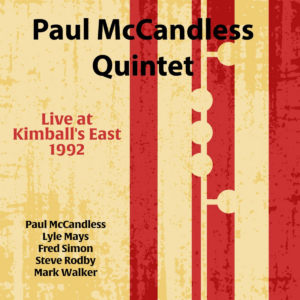
I attended this concert back in 1992. It was an amazing evening. The lineup says it all: Paul McCandless -reeds, Lyle Mays – piano, Steve Rodby – bass, Mark Walker – drums, and Fred Simon – keyboards.
The album they were touring was Premonition, one of McCandless’s best. It was a night which has always stayed in memory, but I honestly never thought I’d get to hear a recording of it, much less 34 years later. Here’s the promo material which gives some background on how this came about:For more than half a century, multi-instrumentalist Paul McCandlesshas been a singular force in creative music, thrilling audiences with a career that bridges jazz, classical, and global traditions. His journey began in the late 1960s with saxophonist and world music pioneer Paul Winter in the groundbreaking Winter Consort, followed in the early 1970s by the formation of the influential chamber jazz quartet Oregon. By the early 1980s, McCandless was also a key voice in Jaco Pastorius’ legendary Word of Mouth big band, further cementing his place in modern jazz history.
McCandless emerged as a bandleader in 1979 with All the Mornings Bring on Elektra, then joined forces with pianist Art Lande and vibraphonist Dave Samuels for the striking ECM release Skylight in 1981. That same year he released Navigator on the Landslide label, continuing to expand his compositional voice. Two major projects followed on Windham Hill: Hearsay (1988) and Premonition (1992), the latter produced by bassist Steve Rodby and featuring an extraordinary lineup of Lyle Mays on piano, Fred Simon on keyboards, and Mark Walker on drums.
That ensemble took to the stage for nine concerts in the summer of 1992, beginning on July 4 at the Montreal Jazz Festival and continuing with a three-night stand from August 21 to 23 at Kimball’s East in the San Francisco Bay Area. One of those performances was quietly captured on a DAT cassette and placed into McCandless’ private archive, where it remained unheard for decades. The tape resurfaced only recently, discovered by co-producer Jon Krosnick while helping McCandless organize material for his website. As Krosnick recalls, after finding a poorly labeled cassette tucked away in a small storage room, he took it home, pressed play, and instantly knew its importance. “We have to release this,” he thought.
Now, thanks to the meticulous sound engineering of Steve Rodby and Dan Feiszli—employing state-of-the-art, AI-assisted mixing technology—that long-forgotten recording has been transformed into Live at Kimball’s East, a professional and vivid document of a band at its creative peak. The release captures the group’s extraordinary onstage chemistry and restores a moment in time that might otherwise have been lost.
For Rodby, the project is deeply personal. Revisiting the music also means revisiting memories, especially of pianist Lyle Mays, whose passing in 2020 left a profound void in the jazz world. A founding member of the Pat Metheny Group and Metheny’s longtime songwriting partner, Mays shared a special musical bond with McCandless—one already evident on Premonition and even more striking on these live performances. On Live at Kimball’s East, that connection unfolds with added intensity and emotional depth, making the release both a celebration and a poignant tribute.
Live at Kimball’s East stands as a rare and powerful addition to Paul McCandless’ remarkable legacy: a rediscovered chapter that reminds us how enduring, and how alive, this music continues to be.
Note that the album is available for preorder and will be released on February 27th (My birthday!) I got to hear a bit of it and it sounds really good.
Thoughts on the inestimable loss of two musical giants

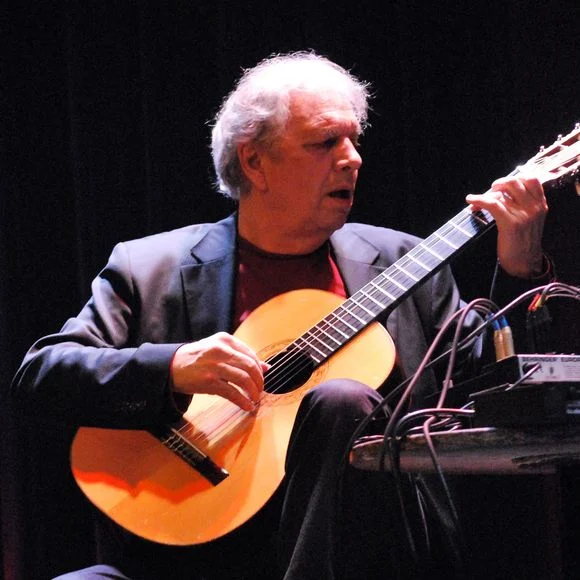
In the past month, we lost two great jazz artists and composers, first Ralph Towner and shortly after, Richie Beirach. Both of these artists were players with an original voice. One could immediately identify either of them within the space of just a few notes.
However, It’s not just a signature sound that defines a great jazz artist; their unique musical vocabulary is also reflected in their compositions. Not every great player can write a memorable tune, especially one that stands the test of time. Both of these artists wrote tunes that were as easily identifiable as the way they played; in fact, playing and composing are really two sides of the same musical coin. Richie Beirach once said that most composers only have one song they’re continually rewriting and, if they’re lucky, they might have two or three. While there is truth to this statement, I think both of these artists broke that rule, especially Towner.During the Covid lockdown, Richie and I became email pals. After I mentioned that I had a lot of his albums, he started sending me YouTube videos of his recordings, accompanied by the challenge, “Got this?” Even though I have an extensive collection of his music, all too often I didn’t have the album in question, and in many cases didn’t even know it existed. It became a game, and over time he revealed to me the vast scope of his discography, which included some 100 albums as a leader or co-leader, not to mention a huge discography as sideman. While not known for being super prolific, in fact he wrote over 300 tunes, of which at least 200 were recorded.
Ralph Towner was equally busy over the course of his career, both as cofounder of the ground-breaking world jazz group Oregon and as leader on a number of group collaborations; he was also a solo artist and sideman on countless projects. He too penned over 300 tunes. Oregon cofounder Paul McCandless once told me that at pretty much any time of the day or night, Ralph was most likely writing yet another tune. He never stopped. This is reflected by the fact that throughout Oregon’s nearly 50-year lifespan, the vast majority of their repertoire was written by Towner.
It was not my intention to compare these two. Yet despite the fact that both were mavericks and in most ways as different in their approach as could possibly be, there are some similarities.
The overlap begins with the fact that both were strongly influenced by classical music, Richie mostly by the Romantics, and modernists like Bartok and Stravinsky. Besides the album “Round about Bartok,” Richie also made recordings titled “Round about Mompou” and “Round about Monteverdi.” His jazz influences were extensive, but Bill Evans stands out. Richie had a personal relationship with Evans, and it left an indelible mark on his aesthetic sensibilities. In fact, both Ralph Towner and Richie Beirach have always mentioned Bill Evans as a primary influence. And it is interesting to note that Bill Evans himself was highly influenced by classical composers, especially the impressionists, such as Debussy and Ravel. And anyone who’s played either of the latter’s piano music, or that of Frederico Mompou or Poulenc, will immediately recognize the kinds of chord voicings Evans used. So there’s a common lineage there.
Towner, a musical sponge, was influenced by just about everything: Elizabethan composers like John Dowland, Latin American composers like Villa Lobos and Ginastera, and also shared Beirach’s love of Bach, the Impressionists and early modernists. He also incorporated African, Brazilian, Caribbean, Greek and other world music influences into his compositions. Richie Beirach’s music, however, has a more Eastern European classical vibe. Besides Bartók’s influence, I also hear Chopin, Stravinsky, and even a bit of Schoenberg in Beirach’s compositions. In the jazz arena, I also hear Herbie Hancock, McCoy Tyner, and on occasion, Monk.
In trying to find contrasts between these two artists, I can’t help but notice just how much they actually have in common, despite how different they sound from one another. Bach, Chopin, Debussy, Ravel — they’re all in the mix for both of them. The difference isn’t so much about influences as how they chose to deploy them.
And it is at this point any similarities end and the differences begin to become apparent. The most obvious difference between these two artists is the fact that Ralph Towner switched from piano to guitar in his early 20s. The move to the classical guitar had an enormous effect on Towner’s style and musical vocabulary. It was the key to Towner’s discovering and defining his unique musical/compositional persona.
While Ralph always chose to play a couple of standards along with his compositions, he was in general a less mainstream jazz figure than Beirach. Beirach, on the other hand, kept his attention on re-harmonizing and reworking standards as a large part of his repertoire, and tended to work in the trio, duo, or solo format throughout his career. While Oregon focused entirely on original compositions, Towner often included one or two standards regularly in his solo concerts and recordings, and continued to do so all the way through to his last album. Also, unlike Richie Beirach, whose entire musical career revolved around the piano, Towner did not only stick to nylon-string and 12-string guitars. While continuing to perform on piano, he added electronic keyboards and in the studio occasionally augmented his recordings with percussion, trumpet and French horn. He recorded several albums on which he played all the instruments himself.
When any musician passes, their compositions and recordings live on, but when a jazz musician dies the unique lens through which their compositions sprang and were constantly reinvented is silenced forever. I know I will never again hear Towner or Beirach play one of their own compositions live as only they could. Ralph Towner never played one of his compositions the same way twice, which is why it was always such a kick to see him perform solo. Solo guitar is a difficult thing to pull off, but when it includes a great deal of improvisation, it’s like walking a tight rope without a net. Yet Ralph Towner did it with aplomb and was willing to take risks. Sometimes that resulted in a flubbed note, but it never bothered me in the least, because I always knew he was always fearlessly going for it, and trying to be truthful to where his ear was leading him. Beirach had that same lightning-fast intuition and risk-taking mentality, and was always intent on finding a new way to interpret an old standard or one of his own tunes. In fact, Richie had such an original harmonic concept that Dave Liebman gave him the nickname The Code. His was indeed a unique musical DNA that infused everything he played. Like Towner, he had an innate ability to reinvent and re-interpret on the fly. Neither of these artists ever played it safe.
These days, all too often I find myself saying that all my heroes are either really old or dead. And the “dead list” keeps getting ever longer. It’s easy to wax Buddhistic and ask, “How could it be otherwise?” The perennial truth is, after all, impossible to ignore. And yet, I still find it difficult to accept the loss of these two great artists who have influenced my personal musical life and given me so much joy for so many decades. I console myself with the fact that they were both well recorded. One thing I know for sure, the legacy of these two giants will live on.Ringing in the New Year with Dino Saluzzi

Ringing in the New Year with Dino Saluzzi I know, it’s a little late for a Best of 2025 list, and as most of you know, I don’t make “best of” lists. But I will add to my last compilation of random brain farts, Dino Saluzzi’s brilliant EL VIEJO CAMINANTE, with Jacob Young on steel string and electric, and Jose Saluzzi on nylon string guitars. It’s one of those sleepers: At first it didn’t seem like a lot was going on, but I kept coming back to it anyway. I even wound up transcribing the first two songs, which the Slo Mo Bros duo has now placed into its ever expanding repertoire. (There are well over 100 mostly “hand transcribed” tunes in our book now.) Honestly, I am tempted to transcribe the evocative and mysterious third tune “Quiet March” as well as several others.
Dino Saluzzi turned 90 last year, and presents himself on this album as an artist with nothing to prove. Indeed, he doesn’t have to. From the beginning of his career, he forged a signature sound on the bandoneon that no one else can match. In that regard, he reminds me of the late Toots Thielmans, who also always sounded exactly like himself once he switched from guitar to chromatic harmonica, also an instrument which very few jazz players have had the fortitude to take on. Both Toots and Dino have a very unique manner of phrasing; both developed a unique way of “skittering across time” in a way that is wholly original and completely natural. Both are also incredibly melodic improvisers, and both were/are still performing at 90!
This album consists of four tunes penned by Saluzzi, three compositions by Jacob Young and one by Saluzzi’s son, Jose Marie; it is filled out with two standards, “Someday My Prince Will Come” and “My One and Only Love.”
The album drips with a kind of laconic, nostalgia that makes one remember another life, a time when things were slower and more romantic. Occasionally dipping into melancholy, this poignant music glistens with the soft focus sheen of golden memories that have been polished to perfection over many well lived decades.
Saluzzi allows the younger players plenty of space to solo and oftentimes lays out and lets the guitars do the heavy lifting. But when he does solo, like all great improvisers, he is a fabulous storyteller. There is something so incredibly personal about the performances here. It’s almost as though you’re sitting in a room with these three players, sipping a glass of cognac around the fireplace, the flickering light filling the room with wistful comfort as your mind drifts to happier years long gone. It doesn’t matter that you never got the chance to visit old Buenos Aires because, by the end of the album, you almost feel as though you had.
The highest praise I can give this album is this: When we had guests over for New Year’s Eve dinner, this is the album I chose to put on. No one said anything about it, but everyone was feeling it warming the room, its simpatico melodies and textures gently wafting around the laughter and conversation as we rang in 2026, hoping against all odds for better times ahead.
Happy New Year to all.
Eating chocolate at the edge of the precipice
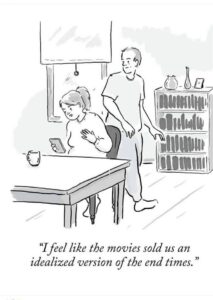
Hello from the crumbling Empire that was once known as the United States of America. We were also once quaintly known as a republic and a democracy. All of that’s a bit sketchy at the moment, and I know that’s not just felt here at home, but all over the world. Therefore, before I get into the body of this post, (whatever it’s going to be,) I feel it would be remiss not to apologize to all my European friends. All I can say is, we tried, but to put it bluntly, as it turns out, you really just can’t fix stupid. The real question is, is DJT that good a con man that he could bamboozle more than half the voting public twice? The resounding answer is unfortunately, yes.
So what does a sensitive soul who is more interested in art, music and culture than the constant beating of the drums of divisiveness and the shrieks of political rancor do every day? I make coffee, of course! I grab my coffee, give myself an hour to view the news and check out the socials, answer email and texts, and then go about my day trying to forget about it, and do something productive and reasonably benign.
For me, that entails sitting at the piano every day, as I once again attempt to heal a lifelong injury that eventually sidelined my performing career. It’s the subject of a larger essay that I am writing, so this is just a teaser. In a nutshell, I discovered the secret to recovery of my particular condition, which is a kind of movement disorder, was to slow down. But not just slow down in th conventional sense, as most of us do when learning to play something new, but to take tempos that one would consider to be almost impossible to consistently feel. I’m talking radically slow, glacial even, or perhaps even at lower “temperatures,” perhaps those one would might find on the planet Neptune. At the same time as I discovered Radical Slowness, the answer also turned out to be the Slo Mo Bros duo. Teaming up with my collaborator and performing partner of some 50 odd years, we started getting together almost 7 years ago right before Covid. Both of us were suffering from some form of injury (although mine’s the more serious one,) and were passionately interested in reworking our technique from the ground up. He’s a classical guitarist and singer who has been playing jazz and Brazilian music for many years, but wanted to get deeper into improvisation on his instrument. So I started thinking about what the ideal music would be for this project. I began writing out the Slo Mos book, consisting of a ton of my own transcriptions of ECM tunes and some pretty obscure tunes from all around the multimusicverse, as well as some of my own things. This is an ongoing project which takes up a lot of my time and energy. Much more could be said on this subject, but I’ll end here for now by saying that what has come out of this process turned out to be far more profound than I ever expected, something that goes far beyond music making.
When I’m not doing that, I’ve been listening to things to take my mind off of the disheartening state of the planet. These days, tend to listen to things that soothe my soul.
I very much like the latest Arvo Part album, And I Heard a Voice. I think it’s one of the finest releases of his music to come out in some years. Perhaps my only criticism is, it’s a bit too short.
I’ve also been listening to Soren Bebe’s new album, Gratitude. Soren has always had a penchant for playing ballads, but this album firmly enters SloMo territory, and my slow world welcomes it. Soren Bebe is an interesting composer. His music is not overly complex, but he almost always throws a harmonic monkey wrench into the mix, a surprising modulation, an ambiguous chord etc, yet always brings you home. It’s extremely approachable, at times almost bordering on cloying, but it never goes there.
I’m enjoying the new John Scofield duo album with Dave Holland. Some people dismiss Sco as too bluesy. I have never had a problem with that – that’s his style. But here is a different side of Scofield, melodic, chromatic, and extremely disciplined in terms of developing his themes. Not much new can be said about Dave Holland, who is simply one of the greatest bass players on the planet. He supports the music and is such a strong soloist. He’s got it all.
I’ve been enjoying Anouar Brahem’s After the Last Sky since it came out earlier this year. I think it’s one of his strongest to date, although there really isn’t a Brahem album I don’t like. It’s so enjoyable that I decided to subscribe to Deutsche Gramophon’s app in order to watch a live concert of this group in Paris. I have since watched it in the archives several times. A very high level of playing going on. Deep listening – every solo, in fact, every accompanying note, is in service to the music. In the concert video, you can see the joy of Dave Holland and Anouar Brahem in a duo where the smiles and intuitive interaction are infectious. The audience picks up on it too, and gives them the most rousing round of applause of the whole evening.
I’m currently digging the Bill Evans remastered Portrait in Jazz and Explorations, which are presented on the new release, Haunted House. There are also a ridiculous number of alternate tracks presented, in fact, a staggering 26, including 17 that have never been released. Most of the time I would say that’s way too much, but this is the classic Evans trio with Scott LaFaro and Paul Motian, so all of it is worth hearing. But the most amazing thing about this release besides the music is the way they remastered it. There is some kind of tone on analog tape, way up there in the high frequencies that they homed in on and realized that they could use it as a means of smoothing out any tape wow and flutter. This resulted in an amazing clarity and solidity to these recordings. I honestly can’t believe how much they benefited from remastering in this way. I think they call it the Plangent process or something. Whatever it is, it’s pretty miraculous.
Another thing I’m enjoying is the newly remastered Beatles Anthology presented here in America on Disney+. These were originally aired sometime in the 90s and present a Beatles eye view of the band through the entire 10 year span of their career. While Paul and Ringo, the two living Beatles at the time it was made, had the most say, there’s enough footage of John and George, so that they get their fair share as well. I haven’t seen these for decades and was pleasantly surprised by how well-made they are and how good they look due to Peter Jackson’s incredible remastering magic. He also edited them so they’re not quite the same as the originals, but I don’t think the differences are that noticeable. There is a new ninth episode, which is all new, culled from some of the extras from the original DVDs as well as unseen archival footage. I haven’t gotten there yet, but I’m enjoying this very much. Giles Martin did an amazing job re-mixing these through a highly evolved process that separated the various instruments so that he could really get a hold of them. Listening to these, one doesn’t hear any of that, the result being it sounds like the music as you remember it, but Way better. Giles has got to be one of the best people out there doing these forensic remixes. And the guy’s got good taste.
Lastly, I’ve been delving into some smart sci-fi. There’s not much in that department to see despite the major releases that keep coming down the pike. In fact, the best sci fi movies today aren’t even movies. Being a fan of the genre, I’ve watched a number of things this year, but the ones that are the most intriguing to me happen to be on Apple TV.
The first one, Severance, has been around for a few seasons, and takes the viewer down a rabbit hole that is frightening, humorous, and surreally allegorical. I’m not going to go into the plot here because it’s so convoluted. I’ll just say it reminds me a great deal of Philip K Dick, who described his work not as sci-fi but as “metaphysical fiction.” I think Severance owes a great deal to PKD, because like the author of Blade Runner, the show’s creators are far more interested in the philosophical and psychological questions that arise than any fat fetched science behind the Deux ex machina that the premise hinges on. This is the opposite of a typical American action film. There are very few if any chase scenes and most of the action is entirely cerebral. The show is also emotionally compelling. There are a few ringers in the cast such as Christopher Walken, John Turturro, and Patricia Arquette, but all the players are strong, as is the almost cinematic direction and look of the series.
Lastly, there is Pluribus, Vince Gilligan’s (of Breaking Bad,) first foray into sci-fi. This series also reminds me of PKD in the best way, because, as he once said in an essay, entitled “how to create a world that doesn’t fall apart in one day”, whenever he wanted to present a metaphysical/existential issue he would just make up a device so that his characters would have to respond to it, as their reality begins to crumble around them.
I guess this is one of my favorite devices because it’s a great portal into mayhem and wonder, terror and bewilderment, philosophical meanderings, and sometimes, but not always, healing and redemption.
Pluribus turns an old sci-fi trope on its head. I really don’t want to say anything because anything I say further about this show is a spoiler and it’s just too good to spoil. I will say this though – unlike so many movies that have used the tropes alluded to here, it takes a sharp left turn and after an episode or two one realizes this is like no other sci-fi show we’ve seen. A lot of profound questions about the nature of humanity and identity are posited, but even to mention one would be saying too much.
Rhea Seaborn, who was the brilliant costar in Better Call Saul, the prequel to Breaking Bad, is perfectly cast in the role of a smart writer with a chronic chip on her shoulder, who is thrust into a completely changed world. She is magnificent in this role. I hope it leads to more leading roles for this extremely gifted actor.
These are just a few things that soothe my soul and give me temporary solace, or at the very least offer consolation in the form of distraction in a world gone mad. I would be curious what yours are.
RIP Garth Hudson, the last man standing
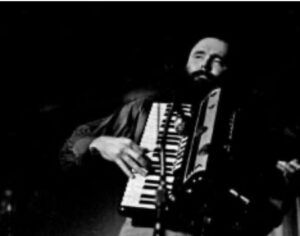
RIP Garth Hudson, The last man standing. Garth was the secret weapon behind the Band’s sound. His organ and keyboard playing, not to mention his accordion, sax and arranging skills, coupled with his vast musical knowledge, elevated the band’s sound, and was the glue that held it all together, but of course it was ultimately the synergy between all its moving parts that resulted in that unmistakable and paradoxically loose knit but at the same time, tight groove they alone could conjure.2024 listening list
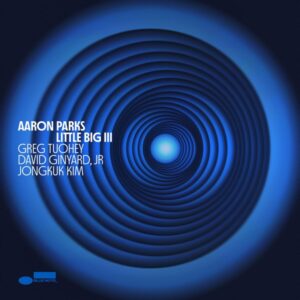
I don’t focus much on new music, nor do I prioritize listening to something based on its being newly released. That being said, here’s a random list of some of the stuff I’m listening to which happened to come out in 2024, in no particular order:
Planetarium – Ben Monder (a monster of a record – (3 CDs and stays coherent and focused all the way thru)
Touch of Time – Arve Henriksen, Harmen Fraanje – (quiet, meditative sound paintings)
Milton and Esperanza – Milton Nascimento and Esperanza Spalding -( joyous, affectionate and intimate music)
Moondial – Pat Metheny – (soothing, calm pieces played on a lovely sounding baritone guitar)
Y’ Y – Amaro Frietas – (earthy, impressionistic, Amazonian jungle sounds)
Little Big III – Aaron Parks – (Little Big’s third album might be their best so far – trippy “jam band” music with great writing.)
Balalake Sissoko and Derek Gripper – Balalake Sissoko and Derek Gripper (Kora master with classical guitarist who has beautifully brought Malian kora repertoire to the guitar)
Taking Turns – Jakob Bro – (lovely stuff, much of which is related to Black Pigeons.)
Celebration – Wayne Shorter (perhaps the best live last quartet album)
First Song – Soren Bebe Trio (another beautiful, understated album by the quiet Danish pianist.)The Sky Will Still Be Here Tomorrow – Charles Lloyd – (a gorgeous album by the master of subtlety.)
Out of Into – Motion I – Joel Ross, Gerald Clayton, Immanuel Wilkins, Matt Brewer and Kendrick Scott – (cutting edge burning state of the art jazz from the next generation of masters.)
I’ve been following Joel Ross’s career for a long time, as well as Gerald Clayton’s. I’ve seen both of them together and separately a number of times and in different contexts. They are both incredible bearers of the flag, steeped in the history and yet looking forwards, as are all their compatriots. Fearless, essential stuff.
A Spontaneous Discussion of Musical Hybrids
[I recently had a discussion on social media with an iconoclastic instrument inventor who had a lot of strong ideas about the state of today’s music and the industry itself. One thing he touched upon was the uselessness of categorization of musical styles. He didn’t like the term “World Music” because he felt every music on the planet was in a very real sense, “World Music.” How could I not agree? What follows is a short essay I wrote when he suggested that not enough cross-pollination is going on in today’s musical realms. He also asked what it might’ve been like if European composers had, for instance, incorporated Indonesian music in their orchestral works.]First of all, in my opinion, the term “World music” is a perfectly fine way to describe music from around the globe. I have no problem with it and it sure beats the term “ethnic”. In truth, I consider all of these categories as arbitrary, and are essentially meaningless, as for the most part they don’t convey any useful information, and are created by suits to describe music primarily so they can sell it. A lot of contemporary artists don’t fit neatly in a pigeon hole.
There’s a lot unpack in your comment, but I’ll just say this: cross cultural pollination is exactly what is happening today and it’s never been more vibrant.
And it goes back a long way:
In fact, European composers did exactly what you have suggested – incorporate gamelan music, and as early as the late 19th were influenced by it. Debussy is a good example: when he first heard a Javanese gamelan at the Paris World Fair in 1889, it totally flipped him out and it influenced his work, especially in pieces like Pagodes.
The first wave of the influences of different cultures always seems to start out as a passing, rather shallow toe dip into foreign waters, usually followed by a much deeper dive. For example, in the European dominated symphonic traditions, we later find composers like Colin McPhee, who lived in Bali for a number of years in a hut in the middle of a rice field, with an old upright piano, and wrote some magnificent music.
in the 50s Lou Harrison, who also studied Balinese and Korean music, composed music for both gamelan and western ensembles. He incorporated some of the Balinese techniques such as kotecan (interlocking parts,) into his chamber music compositions. Check out his wonderful Concerto for Violin, Piano and Small Orchestra. Find the CRI version conducted by Leopoldo Stokowski if you can. A contemporary of Harrison, Henry Cowell was another pioneer in bringing the music of Persia and Asia into Western music.
Also, Jody Diamond of Gamelan Sekar Jaya fame comes to mind. Along with Ingram Marshall, she became an important composer of new music for Gamelan. There is also a new generation of Balinese composers who have in turn been influenced by western composers. There are countless examples of this kind of thing. Indeed, today we live in a world where cross cultural pollination is no longer rare, but in fact, the norm. It’s literally everywhere, in pop, jazz, electronica, classical etc. In a way, this hybridization is the cornerstone of 21st century music. It’s a huge subject, and I’m only going to focus on jazz for the rest of this piece.
Jazz is an art form that started right out of the gate as a cultural hybrid, in this case primarily a blend of African music/rhythm and European harmony, and also soon incorporated popular music from the American songbook, which was sourced mostly from show tunes and films. Later, artists like Dizzy Gillespie became fascinated with Cuban music, and thus began a longstanding tradition of cross pollination between two cultures that is still vibrant today.
The same thing holds true of American jazz musicians like Stan Getz and Charlie Byrd, who started hanging out and playing with Brazilian musicians in the “first wave” in the 60s, but once again, it quickly became a two way street, morphing into an ongoing feedback loop where at a certain point it became difficult to parse who was influencing whom.
Artists like John Coltrane and Miles Davis experimented with incorporating Indian music into their music in the 60s and early 70s. After all, jazz being an improvisational tradition, it seemed only natural for western jazz artists to start playing with Indian musicians. Later, artists such as John McLaughlin (who seriously studied the Raga and Konecal systems) and Indian tabla master Zakir Hussein, who helped bridge the cultural divide from the Eastern side, came together to form Shakti, a true east/west collaboration that remains active today. Of course there were earlier experiments. The much earlier collaboration between Ravi Shankar and Yehudi Menuhin comes to mind.
Another Miles Davis alumni and one of the founding members of Weather Report, Vienna born Joe Zawinul always brought together musicians from all over the world into his bands, which allowed each artist to bring his or her individual cultural voice to the table. I have always thought of Zawinul as a visionary, not just because of his wonderful musical contributions, but because of his utopian vision of a world in which each culture remains unique and distinct, yet comes together to create a harmonious whole.
And any discussion of hybrid music which blends the influences of different cultures would be incomplete without mentioning Paris born Vietnamese virtuoso guitarist/composer Nguyen Le, yet another cutting edge musician who has created a kind of “world jazz” that’s entirely unique, collaborating with African, Moroccan, Vietnamese, Sardinian and American artists (just to name a few,) to create his own unique hybrid.
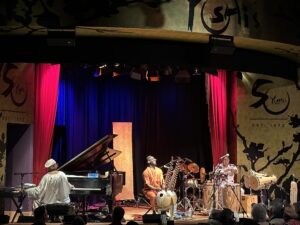
Cuban piano/keyboardist Omar Sosa, has become an ambassador of unique collaborations with artists from other cultures. Pictured above is his SUBA trio with African kora master, Seckou Keita and Venezuelan percussionist maestro, Gustavo Ovalles. Sosa exemplifies the healthy exploration of searching for and finding common ground between cultures.
Tigran Hayasman is another interesting example. As a young boy living in Armenia, he started off as a classical pianist but soon became fascinated with jazz. He was a prodigy, and while still in his teens, won the Thelonius Monk competition. But Tigran quickly outgrew the constraints of the jazz label and started making music which is impossible to categorize. He loved the complex time signatures of his native country and soon incorporated them into his own compositions, combining traditional folk melodies with heavy metal, prog rock, electronica, hip hop, pop and classical music. The result is hard to describe, and while I realize it is an acquired taste for some, I find it challenging, often quite beautiful and staggeringly original.
Last, but hardly least, Oregon needs to be mentioned. To me they exemplify the essence of intelligent, passionate musical cross pollination. They effortlessly blended western contemporary classical, jazz, free improvisation, world music of all sorts, and in the early days at least, East Indian influences in particular, to create an emblematic hybrid that has stood the test of time. Indeed as the decades have rolled by, their importance has only grown in stature.
In this world of ours, which has gotten so much smaller thru technology, this kind of thriving collaborative community is only natural and ongoing in virtually all genres and subgenres.
The subject of cultural appropriation sometimes comes up in discussions like these. What I have learned regarding whether it is appropriate to borrowing from other cultures has a lot to do with the culture one is borrowing from, and the attitude of the person doing the borrowing. For instance, in Bali, my sense has always been that Balinese musicians are very open, and generally love collaborating with people from other cultures. They not only welcome it, they have a long tradition of embracing it. My own teacher in Bali once proudly played me a cassette of himself playing drums with a gifted young Australian blues guitarist. The whole time it was playing my teacher was proudly beaming at me. The Balinese people have always been open to experimentation; I once attended a performance in Bali in which all the musicians were sitting down at synthesizers instead of traditional acoustic gamelan instruments.
On the other hand, my longtime music mentor, who is friends with a number of musical luminaries and considered to be one in certain circles, once told me a story about a famous artist who had borrowed an mbira part which he incorporated into a contemporary track. Apparently, when the African artist who had played the mbira part heard the finished track, he broke down in tears, because to him this was sacred music, and it was being desecrated by being used in what he perceived to be a secular context.
At one point, I was considering taking up the traditional African mbira myself, and the teacher I asked for lessons snubbed me because she felt that I was going to use it in my own music and that I didn’t show enough respect for the sacredness of the tradition in order for her to accept me as a student.
My take on cultural appropriation is that one should always ask one’s teachers and fellow musicians how they feel about incorporating their music into one’s own. That being said, my own experiences have shown me that for the most part, musicians from other parts of the world are flattered when an artist shows interest in their musical culture.
Thoughts on Listening

I am not a quick study when it comes to music. I often describe myself as an eternal student of the craft and spend time every day learning new concepts and getting them under my fingers. It usually takes a year or longer before a concept percolates into my playing.
How that applies to listening to music is that I am by and large not a rabid consumer of new music. When someone recommends an album to me by an artist I don’t know, it takes me a long time to discover what makes that album and the artist tick. If I decide I like it enough to really “take on” an album, that usually translates to hours of deep listening, sometimes study and even possibly a transcription of a tune or part of the solo. In short, I am anything but a passive listener.
This has its advantages and disadvantages. The obvious advantages are, by going deeper into a smaller number of new albums, I gain a deeper understanding of what’s really going on in the music, which greatly enhances my listening enjoyment. For me, listening is a very active thing, and it requires the attention of both my intellect and my emotions. Because after all, on a certain level, what is music, if not mathematics invested with human emotions? In my view, the best music is a balanced amalgam of the two.
The disadvantages are obvious: I don’t seem to have nearly the ability to absorb a large volume of new music as I once did; I honestly envy those who do. I have a friend who used to be the editor of and a contributing reviewer for a prominent audiophile magazine. We recently had a discussion on this very subject and here are his thoughts: “Yes, I’m one of those friends of yours who does NOT listen to a new and much-loved album over and over. I am very chary of overexposing myself to stuff I love and wearing out my appreciation of it. This has the odd result of my greatly loving many recordings without actually knowing them very well. I was sort of naturally bent this way anyway, in a sort of default asceticism, but then my work at (name of magazine) pretty much demanded it. I couldn’t linger. Had to keep listening to, or at least sampling, new disc after new disc after new disc.”
I have another friend who owns around 8000 CDs and thousands of downloads. He recently sent me a large volume memory stick filled with hundreds of his favorite things. He is one of the most eclectic music lovers I have ever met. In this “trove” as he likes to call it, is a hefty collection of classical (he was once a classical radio DJ,) jazz spanning many decades and sub genres, folk, world, esoteric pop and experimental recordings which don’t really neatly fit a category, all of which would take hundreds of hours to sample, much less listen through. There are a lot of wonderful things in there. Of these, I recognize a good portion of the artists and composers, but many are unknown to me. It’s frankly overwhelming. Sometimes I’ll make a coffee in the morning and randomly play something by an artist I’ve never heard of, having no idea what to expect. Yet several months after the memory stick arrived, I have barely scratched the surface.
I’m not sure there’s a point to any of this. I have a couple thousand CDs and a few hundred vinyl albums. I also have a growing collection of multichannel SACDs, DVD Audio and Blu-ray audio discs, and literally hundreds of quad releases which have been generously shared with me over the years. Not to mention a burgeoning collection of HD audio files. In all honesty, It’s all probably more than enough to keep me going for the rest of my life.
Do I Need more new music? Probably not, yet I subscribe to Qobuz and still listen to new things every so often, but not nearly with the frequency I used to. Is it age? I don’t know. An old Far Side cartoon comes to mind. The scene is a classroom and in the front of the room is a kid with a noticeably small head, his hand raised. The caption reads, “Mr Osborne, may I be excused? My brain is full.”
That’s me in a nutshell.Monica Salamaso trio live

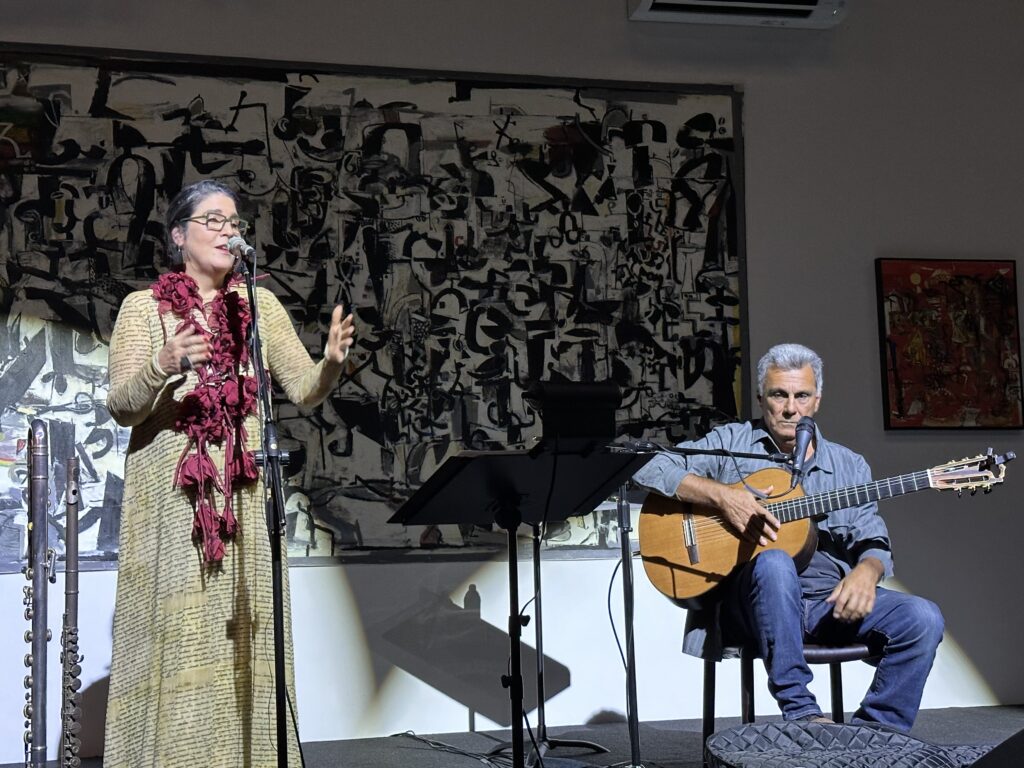
I’ve been a fan of Monica Salmaso for a number of years, first encountering her on a couple of albums by the now defunct group Vento em Madeira. This was a kind of super group of Brazilian artists which created unbelievably sophisticated, free and adventurous music, some of which seemed to be comprised of intricately written out arrangements, but according to Ms Salamaso, were completely made up and refined in the studio on the fly and then rigorously rehearsed. Yet the evolved arrangements are balanced with free playing, loosening up the music with a completely spontaneous vibe that entices the listener to revisit these albums. My favorite of the three albums put out by this group was Brasilia. All three are sadly out of print, but worth tracking down.
Two of the artists featured in that group were in the trio I saw last Saturday evening at the 222, a gallery turned performance space in Healdsburg California. Because of the yearly Brazil camp in nearby Cazadero, Brazilian artists sometimes perform in Healdsburg before heading home. This year, the trio of vocalist extraordinaire, Mônica Salmaso, Guinga, one of Brazil’s most celebrated composers and guitarists, took the stage with the amazing multi-instrumentalist Teco Cardoso on flute, alto flute, bass flute and soprano sax. This trio sounds like a chamber group that happens to play Brazilian jazz, (or perhaps the other way around.) The result was an intimate, passionate performance that pulled on one’s heartstrings one minute and swung madly the next. All three of these artists are virtuosos, but the secret ingredient that really elevates this music is the compositions of the incomparable Guinga. The trio played his compositions exclusively last Saturday night, with the exception of the encore. Guinga’s music is sophisticated both harmonically and melodically, and as complex as some of it is, it gradually gets under one’s skin.
Salmaso possesses an amazing instrument. Sensual, passionate and soulful, this isn’t your breathy Astrid Gilberto type singer (and don’t get me wrong, I like Astrid). Monica’s technique is anything but monochromatic, possessing a palette of colors that covers the entire rainbow of human expression. I only wish I understood the lyrics, because she performs with her entire being, investing her whole self in the stories told in these hauntingly beautiful songs.
Guinga is the consummate accompanist, laying down the backing with a sure hand and an effortless technique, an unerring rhythmic sensibility, all the while casually demonstrating an encyclopedic knowledge of the fretboard, which is always in service to the music. His style is the epitome of good taste. His writing melds the various Brazilian traditions, both folkloric and modern, sprinkling in classical motifs and harmony, occasionally borrowing from the language of Debussy, Ravel and Villa Lobos.
Teco Cardoso delivers a varied banquet of colors on his flutes and sax. He started the set on the rare bass flute, which he played exclusively for the first few tunes. He layed down deep, tasty solo lines, countermelodies and audible percussion parts played on the instrument’s keys. Teco seemed to favor the soprano sax for solos, each one a textbook example of perfect execution and conception, infused with fiery soul. His is a jazz oriented vocabulary, but he peppers it with folkloric flourishes and the result is utterly enchanting. At one point he brought a set of indigenous double wooden flutes, which I first heard on Egberto Gismonti’s classic Solo Meia Dio. But being a wind player, Cardoso took it up several notches, and mesmerized the audience with his bird calls and lovely melodic fills, instantly evoking the depths of the Amazon jungle.
Although the trio leaned heavily into slower, introspective pieces, make no mistake – this little group can really groove. Monica sometimes played pandeiro (and even a camping frying pan,) and really kicked up the excitement on the sambas.
I have a number of Salamonso’s albums. They are all quite different from one another. Some are quite densely arranged, as on her 2004 release, IaIa, and in contrast, her more recent Milton, which features Milton Nascimento’s compositions exclusively, is accompanied solely by master pianist, Andre Mehmari. I tend to prefer the less dense albums.
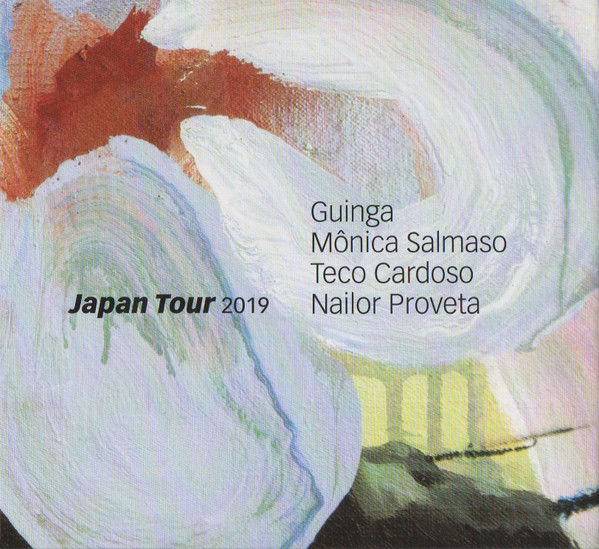
I searched to see if the trio I saw had any albums out, and the closest thing I could come up with was the Japan Tour 2019, which features the aforementioned three players with the addition of clarinetist Nailor Proveta. It’s a wonderful live performance which features a number of pieces featured in the set I heard, and really captures some of the magic of that memorable evening.
Romantic yet unsentimental, this music covers the spectrum of human emotion. I highly recommend exploring this artist and her talented compatriots.
Milton + esperanza

The new album with Esperanza Spalding and Milton Nascimento is a joyous affair, filled with unexpected sounds and colors that only these two artists could conjure. I believe it’s meant to be played all the way through, as the album weaves in and out of contrasting intimate tone poems and larger scale orchestrations, stitched together by little snippets of conversation filled with laughter, while Milton muses on his 60 year career in music.
When people used to ask me who is this Milton Nascimento, I would struggle to find a description. I used to call him the Beatles of Brazil, for his originality and commitment to his very personal musical convictions (and perhaps because Milton is such a huge fan of the Beatles,) but nowadays I refer to him as the Paul Simon of Brazil, for his continual search for new sounds and his intelligent, heartfelt lyrics. Milton is not merely a lyricist, but a true poet.
Over the course of his career, many artists of different stripes have wanted to work with him. Just listen to a personal favorite, his amazing album, Angelus. Here we find among others, the arranging skills of Gil Golstein, voices of James Taylor and Peter Gabriel, as well as contributions from jazz giants Herbie Hancock, Pat Metheny, Ron Carter and Jack DeJohnette, not to mention the exoticism of the unique instrumental quartet Uakti, all on one generous 80 minute long behemoth of a recording.
In contrast to the ambitious studio sprawl of Angelus, Milton + Esperanza is a more focused, intimate recording, made in the autumn of Milton’s life; in fact, most of the tracks were recorded in his home.
In Milton’s vocals, one can hear a lifetime of hard earned wisdom, which, although a bit rough around the edges, still communicate a depth that if anything, time has only honed and deepened. Think of Kenny Wheeler’s last album, Songs for Quintet – That’s how Milton’s voice comes across – aged yet burnished to a fine finish by time.
Besides revisiting a number of Milton’s tunes from his storied career, Esperanza contributes four of her own tunes and vocals on a number of duos, mostly sung in Portuguese, as well as some solidly supportive bass playing. The album also includes a beautiful, somewhat avant garde version of the Beatles A Day in the Life, as well as a cover of Michael Jackson’s Earth Song. It concludes with a cover of a Shorter song, When You Dream. Originally sung by Shorter’s daughter on the landmark album Atlantis, it is sung here by Shorter’s widow Caroline, who Shorter had urged to sing more often, saying the world needed to hear her voice. I think he would’ve been proud of her performance.
Esperanza seems to have a natural affinity for her elders, something she says goes all the way back to her childhood. She was good friends with Wayne, and collaborated with him in his last years on the opera Iphigenia, in which she also performed the lead role. And of course, there’s that special connection between Wayne and Milton, captured so beautifully on the timeless Native Dancer. Considering their mutual friendship with Shorter, it seems that much more fitting that Spalding would make this album with the elder artist. Indeed, at the heart of this project is the friendship between two artists from two different generations, brought together through their shared love of the music. The love and affection between the two is palpable on every track.
Speaking of Paul Simon, Simon sings on the Nascimento tune, Um Vento Passo, in Portuguese no less. Somehow, two of the most different voices in the world find a way to blend together seamlessly. Other guests include Dianne Reeves and the Brazilian guitar maestro Guinga. Multi winds instrumentalist Shabaka Hutchings appears on the album as well, adding beautiful colors to this richly textured recording.
Special mention should be made of the recording itself, which I’m guessing makes use of some of the latest psycho-acoustic 3-D effects. Even though it’s not mixed in surround, it seems to swirl around the room and immerse the listener. I actually had to check my rear speakers to see if they weren’t playing.
This album was obviously a labor of love, and is a fitting tribute to one of the most distinctive artists Brazil has ever produced.HERE is a lovely 20 minute live Tiny Desk concert with special guests, filmed in Milton’s home.