Uncategorized
Strandlektüre für Rantum im März

Geradezu „entdeckt“ habe ich einen „Professor of History at Middle Tennessee State University“! Ein fundiertes, alle Sinne ansprechendes Büchlein über John Cales „Paris 1919“. Auch wenn er zuweilen in munterem Galopp durch die Histore jagt (mit pointierten Pausen des Verweilens), von Versailles 1919, über Dada und Surrealismus und Dylan Thomas bis hin zu Andy Warhol und Fluxus, nimmt er all diese Hürden en passant, ohne oberflächlich zu werden. Alles kreist, bereichert mit spannenden Tangenten, um diesen gespensterreichen Songzyklus, voller Hintergründe und „sidesteps“.
Mir gehen reihenweise Lichter auf. Ich schätze zum Beispiel, wie Mr. Doyle die Unergründlichkeit dieser Lieder herausarbeitet. „Mark Doyle runs down the ghosts haunting Cale‘s most enduring solo album.“ ich begab mich ratzfatz auf seine Spur. Es gibt natürlich etliche Mark Doyles, aber genau dieser veröffentlichte 2020 auch ein Buch über die Kinks, Untertitel: „Songs Of The Semi-Detached“.
Die Helden meiner Kindheit und ihre „Psychogeographie“: die Kinks rangierten damals in meiner Welt knapp vor den Beatles. Und 1976 weigerte sich ein breites Honigkuchengrinsen , eine runde Woche lang in Würzburg mein Gesicht zu verlassen, als dank des bayerischen Zündfunks die Langspielplatte „801 Live“ meine Studentenbude flutete, Phil Manzaneras Super Group mit meinem damals brandneuen „Helden“ Brian Eno als Sänger und Synthesizerspieler, und seine „hot takes“ von „You Really Got Me“ und „Tomorrow Never Knows“ mich im Sturme nahmen, wie im gleichen Zeitenraum auch „Miss Shapiro“, und überhaupt das pure very britische Seventies-Opus „Diamond Head“.
Tja, und obwohl ich BRAVO-sozialisiertes „human being“ viel über die die Kinks wusste und weiss, mit all ihren Umwegen über „5 o’clock tea“, Carnaby Street, The Village Green Preservation Society und USA (und auch über Ray Davies’ innere Distanziertheit zu überschwappendem Flower Power), freue ich mich wie Bolle auf Boyles 213 Seiten am Meer, sowie einen historischen Kriminalroman, der in den holländischen Bergen spielt anno 1961, sowie auf Martina W.‘s Anthologie „Und man hört sie doch“, die tatsächlich schmökertauglich ist, sowie, bald oder etwas später, Jan R.s jüngsten Streich über einen mir weitgehend unbekannten Künstler. (Der hervorragende, 1975 und früher spielende Gesellschaftsroman „Der Gott des Waldes“ von Liz Moore, Krimi, Survivalkurs und tiefenpsychologische Finnesse in einem, ist soeben erschienen, und wurde leider schon von mir in atemraubendem Tempo verschlungen.)
Der Koffer ist gepackt, das Haus am Meer wartet auf mich, es hat einen Cd-Spieler, und ich wieder mal nur Ausgesuchtes dabei, sowie „Paris 1919“, dann die neuen Werke von Alabaster DePlume, Vijay Iyer & Wadada, zudem und sowiesoso „Grosses Wasser“ von Cluster (das lange Stück!) als auch Philip Jecks Vermächtnis „rpm“ (was gibt es Rauschenderes und Knisternderes als Jecks Vermächtnis nachts in „Klein-Afrika“ zu hören, auf Kopfhörern, die dem Sound der Wellen natürlich Einlass bieten!?)…
Für Scotch und Candlelight auf El Hierro und sonstwo
Der vertraute Klang eines Cocktailshakers voller Eis und entfernter Möwen weichen einer einfachen Melodie, einem im Licht sich räkelnden Rhythmus. Wir befinden uns auf einer Zeitreise in ein Japan, das bald eine halbe Ewigkeit zurückliegt. Die Siebziger Jahre des 20. Jahrhunderts, jene tollkühne Dekade. Wir träumten damals vom Fujiama, der uns auf grossen Briefmarken entgegenblickte, verspielt und majästetisch, als wir baby boomer waren. Japaner träumten anders. Und so befinden wir uns gerade mitten in einer Musik, die deren ausgesuchte Urlaubsparadiese zu damaligen Wirtschaftsblütezeiten heraufbeschwörte. Die südlichen Inseln im Pazifik.
„Pacific“ ist der Titel dieser Langspielplatte. Das Werk entstand 1978. fast alles instrumental, bis auf die eine Zeile, die mit dem „Sommer in ihrem Haar“ alle Träumerei auf den Punkt bringt. Die drei Pazifikforscher: Shugeru Suzuki, Harry Hosono, der bald das Yellow Magic Orchestra mitgründen sollte, und der Dritte, einer der Cracks der japanischen City Pop-Szene, Tatsuro Yamashita. Wir erkennen einen alten Bekannten, der auf dem Album auch mitmischte, Ryuichi Sakamoto. So jung, man glaubt es kaum. Eine Prise früher Synth-Pop, die japanische Variante amerikanischer Exotikträume a la Les Baxter, melodische Funkrhythmen, ein schwebender Horizontöffner, eine Brise New Age, easy peasy, soft and breezy.
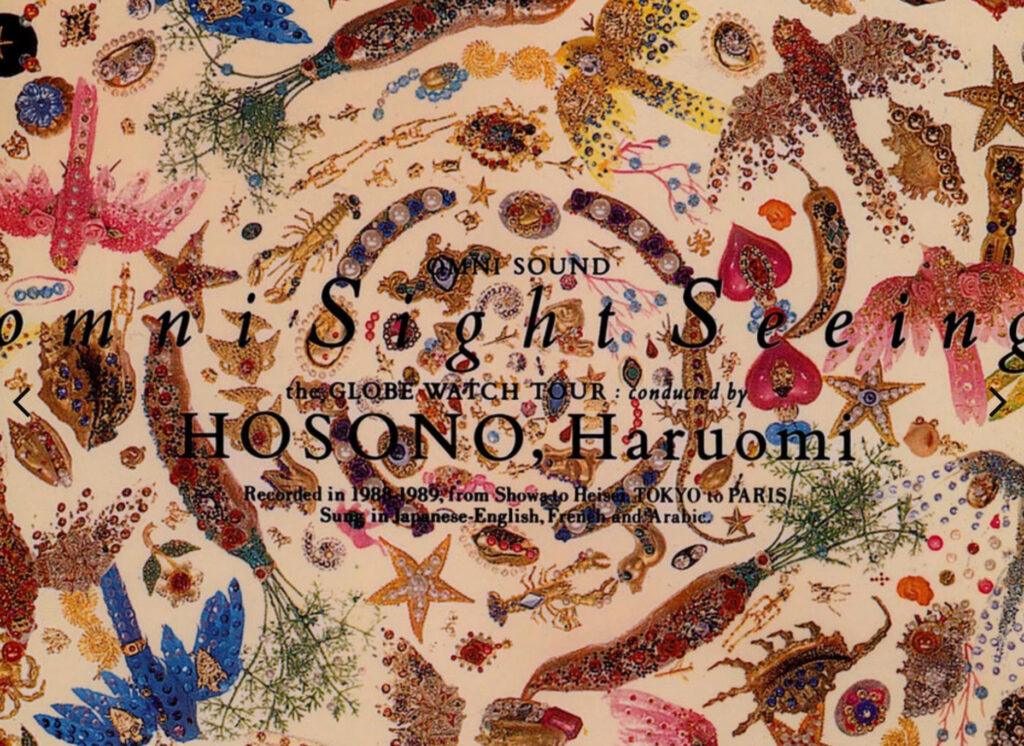
Ein gutes Jahrzehnt später. “I follow the peacocks as they sing like wo la la la”. Das Album: OMNI SIGHT SEEING. Anno 1989. . In den Achtzigern war „Weltmusik“ angesagt, aber vieles von diesen globalen Sounds hielt eine geschmäcklerische Sanftheit parat, mal virtuos, mal berechnend, und oft genug war das vollmundige „CROSSOVER“ einfach langweilig wie effekthascherisch.Wenig kam heran an die rohe Wucht und Durchschlagskraft von „My Life In The Bush Of Ghosts“ von Eno und Byrne, an die surreale Magie von Jon Hassell und den drei Codona-Alben auf ECM. Einiges wohl, aber vieles nicht. Und da taucht nun, als Reissue bei Victory Records, diese Platte auf, die diesen Globetrotter-Modus auch noch auf das Cover setzt, als Untertitel in schwarzen Lettern: „recorded in 1988 – 1989 from Showa to Heisen, Tokyo to Paris, Sung in Japanese-English, French and Arabic“. Und was darüber steht, wirkt wie eine touristische Animation: „omni Sight Seeing / the GLOBE WATCH TOUR: conducted by Hosoni Haruomi“. So weit, so gewöhnungsbedürftig.
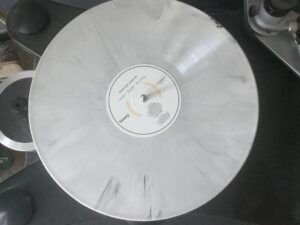
Ich besorgte mir das Album, weil ich Haruomis „Pacific“ vor Jahren als Entdeckung empfand, und einmal mehr überzeugt mich auch dieses Werk von Anfang bis Ende, warum, genau, kann ich aber kaum sagen. Es geht ja auf der Rückseite des Albums, im Kleingedruckten, noch weiter, und wenn man da von „Astralreisen“ liest und „spiritueller Reise“, noch dazu in recht plakativer Sprache, fragt man sich, ob der Gute zuviel Kaffee im Nirvana getrunken hat, ein romantischer Schwärmer ist, oder reale Grenzerfahrungen in Klänge übersetzt.
Denn dieses Album ist ein Tollhaus von kreuz und quer purzelnden Einfällen (das Cover passt da schon wunderbar!). hosono Haruomi in einem Samdkasten aus Alphaville. In eine japanische Technovariante mit Härte 8 schmuggelt er Bandoneonistas hinein, marokkanische Herzensgesänge, ein fröhlich aisflippendes Saxofon, um danach in einem wundersam floatenden Ambient Track jeder zerfliessenden Sekunde gewisse underwater vibes unzerzumischen – call it „balearic“! Schön verrückt und erfinderisch seine elektronisch unterfütterte Version von Duke Elllingtons „Caravan“! Alles kommt mit einem ausgeprägten Spieltrieb daher, und könnte leicht als nette multikulturelle Petitesse durchgehen, aber es fesselt mich, sorgt für Heiterkeit, Wundern und schöne Verblüffung. Seltsam.
Radio On
Today I got Alabaster‘s answers for the Klanghorizonte at the end of March. If you look at my playlist in motion, there are not many questions open in regards to the playlist, except the final piece, or playing three ECM‘s in one hour. I will ask for that, good arguments I have. There‘s is a fine connection over decades between Paul Bley‘s Open, to love and Jon Balke‘s Skrifum, for example. Anyways, HEAR the kind greetings from Alabaster! Afterwards he spoke about two songs, his saxophone paying and much more. HEAR The Hebina, Hebina story! Kindred spirits in peculiar ways, Alabaster and Brian! (I will write that hour on Sylt, cold cloudy winter days will be guaranteed.)
Neues von Brad Mehldau
Ein Freund schickte mir Ausschnitte aus dem Buch von Brad Mehldau „Formation – Building A Personal Canon. part 1“. What a pleasure to ready it.
“My first memorable strong connections to music were through the clock radio in my bedroom in Bedford. I got it for Christmas when I was seven years old, and I listened to the hits of that period. As I didn’t have a record player yet – that came a year later – I would hear a particular song, fall for it, then simply wait around until it was played again. I would try to catch it when we were in the car, when I was allowed to sit in the front seat and choose the station. The other place I would hear those songs was coming from the lifeguard’s transistor radio at our public swimming pool, where I spent many days in the summers of 1976-79. I got lost in them. I can still smell the chlorine and feel the hot cement and the warm sun when I hear those songs from that time. I can feel the sweet anticipation in my belly as they begin. I hear them now, and they’re like a good dream I’m recalling. There’s a sad kind of feeling of something that’s gone, but there’s an ache of happy yen all mixed up in it. There’s something that I can never get back, but here’s the thing: maybe I never had it. The first time I heard it, it was already like a dream – it was already beckoning me to somewhere that was better than here. The music showed me that place, but I could never really enter into it. So when I go and try to make music every time, I’m trying to crawl back into that dream. Even though I can’t, echoes of it remain everywhere in this world of action, and experiences add more colors to it, and soften or sharpen the hues that are already there. The dream and reality stand apart, but they’re wrapped into each other at the same time. Music is not so much the gift itself, but the slow, endless unwrapping of it, and a hint of what might be under the wrapping. What lies there is the Absolute: God. He is infinite; I am not. Music is both the expression of my finitude, and its consolation. I walk towards God in an asymptotic line, never quite meeting him directly. Yet there is evidence of this absolute, abiding presence here and now, in the music, every experience that informs that music, and every experience it informs in turn, in a perpetual exchange.” “My first time hearing Coltrane’s music was an initiation, and it was ceremonial, like an Indian sweat lodge. The cabins were hot during the day, and usually we would just stay outside during those hours when the sun peaked and find some shade. But Louis and I went into the cabin, and we shut the door and kept the windows shut. We sweated and listened to the Coltrane Quartet for about half an hour on his cassette player. When we emerged again from the cabin, I was changed. Sometimes music can do that to you. It raised the bar for my expectation as to what music could be. The intensity of the Coltrane was something I chased thereafter as a listener. Later on, when I became a jazz musician, it was the ideal when I played. The idea was to change someone’s perspective – really, to change their life – through your playing. If you failed, and you might fail most of the time, the effort itself was noble. Through my other cabin mate, Joe, who was a piano player like me, a year older, I discovered Jimi Hendrix. We listened in particular to the live album, Band of Gypsys.” “For me, it never felt like we were merely aping those greats as a means to an end. It was a way of moving towards my own sound. And, even if I was aping, it was so much fun. We were having this conversation about the music we loved – by playing it, with all our heart. There was a whole swath of us piano players who were trying to play like Wynton Kelly, the great hard bop pianist who graced so many important records of that era. Sometimes, someone would simply play a whole stretch of one of his solos, transcribed from a beloved record. Normally, that kind of thing would be frowned on, because it went against the principle of improvisation but, here, the fellow piano players who knew the solo as well would give assent and nod in approval. I did this with several choruses of Wynton Kelly’s solo on „No Blues“ from the Wynton Kelly Trio/Wes Montgomery record Smokin‘ at the Half Note. I still quote from that solo regularly. It’s a bedrock of joyous swing, melody and badassed fire all at once. Ditto pianist Bobby Timmons’s solo on „Spontaneous Combustion“ from The Cannonball Adderley Quintet in San Francisco. I wouldn’t be who I am without those solos. We pianists wanted Wynton Kelly’s crisp articulation but, more urgently, his feel. Your „feel““ in jazz parlance, means the way you sit in the swinging rhythmic pulse of the music, or you could say, where you sit, which part of the beat you lean into: the front end, the back end, somewhere in between, or maybe a shifting mixture of all of the above. Kelly laid in the back of the beat, and the way he swung was completely unique, and remains so in spite of being imitated by many. I can’t hear where he got that feel – I think it was something elemental in him – but you hear lots of pianists who grabbed onto it. Just listen to Herbie Hancock on his early Blue Note records, like Takin‘ Off. Kelly’s comping was influential on Herbie as well. People think of Wynton Kelly as an „inside“ player, but he was the first piano player in the small-group jazz setting to comp in a way that wasn’t part of the rhythm section grid. He paved the way for the more interactive comping that Herbie Hancock and others would take up after him – jabbing and interspersing stuff between the soloists‘ phrases, adding punctuation marks. It’s a common understanding that Miles called Wynton Kelly in for „Freddie Freeloader“ on Kind of Blue because he wanted something for that tune that was Blacker – bluesier and more swinging – than what Bill Evans could supply. That may be true, but it’s a backhanded diss to Kelly, because his comping was every bit as subtle as that of Bill Evans. Wynton Kelly dotted his eighth notes quite strongly, and in his own hands the effect was exhilarating; it has that joyous tension and relaxation all at once. It makes you want to move, and if you don’t dance outright some part of your body will be squirming happily. Yet in someone else’s hands that unabashedly and more often than his own model, Bud Powell. He often did that right in the middle of a pretty ballad and made it work, like on „If You Could See Me Now“ from Wes Montgomery’s Smokin‘ at the Half Note. It was never trite. Herbie, being Herbie, was able to fold Kelly’s influence into his own con-ception, which was already showing itself on Takin‘ Of. Many players, though, go for Kelly’s thing and it doesn’t work. It’s the sound of a relaxedness that no one else wants – like a guy who wears a muscle shirt when he’s a little too overweight to pull it off, and his tits stand out. This kind of unwelcome let-it-all-hang-out feel is a common jazz virus. The other problem is when you’ve got Kelly’s spirit well enough but you’re simply not as strong rhythmically, your touch is too soft, or your articulation not as crisp. It’s a flabby kind of playing Jazz fans and musicians alike complain about the „tightness“ of someone’s swing feel. Tight playing is certainly a phenomenon, but I don’t believe it’s due to some incurable lack of hipness, lack of sexual experience, or any of the other clichés one hears. Rigidity of swing is often rooted in lack of self-assurance. That may come from lack of experience and, further, a lack of proper technique. Technique gives one self-assurance because it provides physical relaxation. If you look at a tight player, you’ll usually see it in their body language. In any case, I started out corny and tight, and became less so as I gained technique and, with it, relaxation.” “When Wynton [Marsalis] played, it sounded like he knew what he wanted me to hear. It played well into his mission to teach listeners about jazz. That didacticism in the music itself was not available to me; in any case, I did not pursue it. It wasn’t that I didn’t care what the audience thought. Rather, the music unfolded in such a way that I only knew what I played after it happened. I couldn’t lead the audience anymore than to say: go out on a limb with me and let’s see where this goes. In some of the musicians I loved the most, there was also a feeling that they didn’t know where they would wind up, and that it might all just fall apart at any moment. In fact, my favorite moments were often when the canvas cracked and splintered, and the imperfection rose to the surface. There it was: the bare-assed exposure of a musician’s disfigured, true self. Yet that was no simple failure. It was the ambergris in the perfume, the smelly human underbelly beneath the handsome torso. It made the beauty more compelling. Vulnerability was not a virtue in itself. If someone always conveyed it, it became as insufferable as ceaseless impenetrability. Yet it could invite a listener towards self-forgiveness. Redemption-through-error was part and parcel of the improvisatory aesthetic itself. Beauty was indeed on display in the finished product, but just the endeavor to make beauty, to push past your own handicapped frailty, had beauty. I could lay my chips on that logic because it seemed to come from a primal, shared experience: When you were young, you had an aspiration. But then you damaged or broke something in your naive ignorance, for all to see. Someone showed you mercy, though, because that person had once shared your aspiration – they empathized with you – and you had dared to try. Your own failed effort was not only forgiven but it was preserved in the redemption. In musical terms, that meant that, if you fell on your ass on the bandstand in the search for beauty, it wasn’t necessarily a negative in the long run. I found that vulnerable feeling in musicians like Billie Holiday, Lester Young, Booker Little, Wayne Shorter, Chet Baker, and of course Miles. „The Buzzard Song,“ the opening track of Porgy and Bess, Miles’s collaboration with arranger Gil Evans playing the music from Gershwin’s opera, is a strong example. He delivers the opening doleful melody with such hesitancy. It’s so intimate because he has no defensive armor; his playing has this beautiful uncertainty to it. There is a risk in that kind of playing – what if you get burnt, what if you get laughed at? Here, I’m speaking mostly of a masculine phenomenon. As crazy as it sounds, when I arrived in New York, a lot of male aspirants like myself, depending on what they were bringing already from their background, shied away from ballads for that reason. Miles made it okay for other male musicians to show their ass and not just wag their dick. He was a model they benefited from, because he gave them a safe space for what was already inside of them. Listen to trumpeter Kenny Dorham’s plaintive solo on „Escapade“ his own masterful composition on Joe Henderson’s. Blue Note date, Our Thing. You hear doubt and foreboding even as hope tries to push through. When I hear playing like that, I experience kinship. Being vulnerable in the music, versus directly communicating it to someone else through words or actions, was appealing for me. My Cain was different, and maybe that was cool to a degree, but he was also secretly unsure. that lack of self-assurance was repellent to me in its outward manifestation socially, and inwardly in the self-loathing monologue going on between my ears. Yet, when I could express vulnerability in music in addition to the confidence that was already there, it gave me a more integrated version of Cain. On the one hand, there was the guy saying, „‚ve been cast out and I’m not sure who I am. But there was also the guy saying, „This is me – I’m going to pull you over into my tribe: just wait.“ I was both when I played, even if I couldn’t be anytime else. Miles showed the way. When „The Buzzard Song“ breaks into swing after the opening melody, he is unstoppably self-assured. He’s flipped the script. It’s all the more badassed because we already know who he is on the inside. He catches us off guard. His self-assurance is so much more interesting because we know it’s not all there is to him. It’s also a surmounting- he is the victor over his own doubt. The doubt he initially expressed becomes more compelling retroactively because we see it was a strong person who doubted. There is still a sense of foreboding, interlaid within the strength. This deep irony on the emotional level was only achievable by him through initially conveying weakness. That kind of expression was sexual for me when I heard it, sexuality sublimated in music. It was about showing something personal, passively, and then taking charge – all within one performance. I’m not sure if anyone will pull that off again like Miles. Vulnerably uncertain is not the only way to sound, especially not for trumpet players. Thank God that Freddie Hubbard was Freddie Hubbard through and through. The trumpet can swagger like nothing else. Still, something magic happens when that swagger is tempered by uncertainty. The rub between the two is what makes trumpeter Lee Morgan’s music timeless – Lee Morgan, the perfect jazz musician, if there ever was one. The blues was in everything he did, his rhythmic phrasing was always interesting and never locked in a grid. He had more swagger than just about anyone.” “It was the unspoken subject of the music. I don’t mean finitude of musical ideas. I mean finitude as our existential condition. Beauty is beauty because beauty is temporary, and beauty is temporary because we are temporary. Our mortality is the birthright that angels can never possess. To seek beauty was to seek an affirmation of life, even as you knew it wouldn’t last.” “Barry Harris was a model not just because of his mastery of a particular musical language, but because his melodic phrasing was so free within that language. Pianist Tommy Flanagan exemplified that as well. I was fortunate to hear Tommy several times in New York. His, dising in the latter years of his caret had reached a peak level of refinement, distilled in a beautiful trio setting with basist George Mraz and great trio drummers like Al Foster or Kenny Washington. There was always all this room in the music, room to breathe. To some, Barry and Tommy may have seemed bent on preserving a style that had passed, but that wasn’t true at all. By the time we arrived in New York, they had achieved poetic justice, if you had ears to hear. Bebop, as it was written on walls in the East Village, really was the „music of the future. Barry, far from being a throwback, was a Futurist for us. Barry’s teaching style was solidly didactic, but it was more compelling for us at that point than the frontal assault that Wynton was heralding uptown. Wynton advocated a return to authenticity, critiquing the development of jazz, as it began to draw outside influences like rock’n’roll into its expression. it was a global critique, in broad brushstrokes. Yet his music seemed no freer as a result. As vital and influential as Wynton was during that time, his music did not convey the mixture of looseness and profundity of any number of older musicians on the scene then. We wanted something we called „between the cracks.“ Barry and others had it. „Free“ had nothing to do with atonality or lack of structure. It was a feeling, not a dictum. It was either there in the music or it wasn’t.” “Like all those kinds of designations, Americana was a term that appeared after the music had already come into being. It was a sound you could hear already in Charlie’s contribution on Keith Jarrett’s 1975 ECM record Arbour Zena, and I got a little taste of it a few years later when I played and recorded with Charlie on his album American Dreams – you can hear it strongly on the opening title track. The way I would describe Americana is that whatever it reminds you of depends on music you already knew, the common link being a North American source (thus including great Canadian artists like Neil Young, most of the members of The Band, and Joni Mitchell). For me, the sound of „American Dreams“ – the harmony, the spaciousness – was connected to Aaron Copland in a piece like Appalachian Spring. Ironically or not, a lot of the Americana music I discovered in my Bildung was released by a European producer, Manfred Eicher, on his ECM label. It may have confirmed the truism that one sometimes sees what is special about a culture when looking at it from a distance. In any case, we can all thank Manfred for documenting so much great music. Another musician who influenced me greatly was Keith Jarrett, and, while I hesitate to assign genres, no matter how pliable, to any of these great figures, Keith’s solo output spoke to me in a similar way. The first record I heard from him was the triple-LP set Bremen/Lausanne. It was a birthday gift I received from Dylan, of all people, that last summer of our tumultuous friendship, and it immediately changed my take on what was possible in music, in the same way that the Coltrane with Louis in Merrywood had the previous summer. I had heard a fair amount of jazz by that time, but this was something different. I initially connected Keith’s solo output on records like Bremen/Lausanne, Staircase, and The Köln Concert(…) There were all these lines you could draw between artists who were on the face of it very different in their designs, but the thread was emotional, and the emotion was often something like nostalgia, home and hearth, melancholy at times but, under all of that, quiet, abiding joy. It was like some kind of unspoken secret they were telling me about myself, and about whom I could become as a pianist, whether it was the sturdy weaving of George Winston, the busking arpeggios of Billy Joel, the wistful boogie-woogie of Guaraldi’s „Linus and Lucy, or the exalted vistas that Keith Jarrett reached. I remember that, after I had been listening to the first side of Bremen/Lausanne for weeks, one evening I sat down to play on our Sohmer spinet in West Hartford, and something came out of me that was inspired by Keith’s playing, something that seemed to have come from nowhere in terms of preparing for it in any way. It had that feeling of time traves got from the fantasy and science fiction I was reading – that large, endless scope – because what Keith inaugurated in those solo recordings was improvised music on an epic scale: music from one person alone that journeyed widely in one sitting, full of turmoil, joy, and mystery. It was a powerful experience, and I would meet it again a couple decades later at the beginning of my thirties, when I began to speak my own solo voice. Solo piano for me has always been just that – solo- in terms of a certain courage one must have to make a solitary improvisatory journey, with no companions. That is both its romance and its challenge.” “With Pat, the sublime was just as much a physical feeling. As his solo continued, I had the sensation of something overpowering welling up in my stomach and then emanating outwards towards my heart and through my whole body. I experienced that same welling years later when our first child was born, and I was there to see it. On that solo, Pat ran his guitar through a Roland GR-300 guitar synthesizer, and the wailing sound he got was like nothing else. It pushed its way immediately to the front of the top ten of my air-guitaring list, in a tie for first place with Hendrix’s „Machine Gun.“ … EXCERPTS FROM BRAD MEHLDAU’S NEW BOOK OF REFLECTIONS ON BEING AN ARTIST
A documentary on a key figure of IAR: Makaya McCraven

McCraven’s second album proper of ‘organic beats music’ almost incidentally internationalises the new London scene, bringing its figureheads into a bigger world. The Chicago-based drummer/ producer also offers a belated sequel to Teo Macero’s ground-breaking electric Miles cut-ups, by subjecting live improv to extensive post-production. His quest for raw material ranged from Chicago to a Queens basement bar, an LA garage and London’s cruelly closed scene-catalyst Total Refreshment Centre. Searching for the specific in these scattered local musicians, McCraven’s production then blurs borders to reaffirm their underlying community. When applause washes over the chopped up, yet flowing, soul-funk of ‘Young Genius’, and McCraven’s cymbal-splashes softly, seismically ripple, there is a constructed sense of organic place. Time, too, is reconfigured but real, retaining improv’s in-the-moment spark. (Nick Hasted, Jazzwise)the 100 records that all came to me „like a hurricane“ in the wild, wild 70‘s
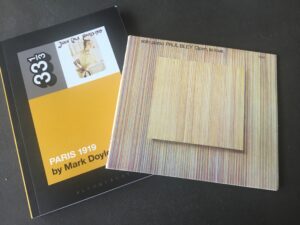
Früh am Nachmittag kam ein Päckchen, darin Mark Doyles beeindruckendes Büchlein über John Cales „Paris 1919“ (ich fliege gerade im Kindle durch die 120 Seiten) und – sehr preiswert (ich verschenkte es schon diverse Male) – Paul Bleys „Open, to love“ als digipak-Cd. Ich stockte: „Na hör mal“, sagte ich zu mir, „das ist doch Synchronizität“. Ich schaute nach, genau: beide Platten erschienen 1973! Und das waren wohl die beiden besten Alben jenes Jahres, naja, vielleicht würde ich ihnen noch ein, zwei, drei, aus meinem 18. Jahr an die Seite stellen. Denn jenes Jahrzehnt war wirklich verrückt. And completely overflowing with lessons of love, life, magic, and death. I‘m still learning them today. Learning to fail. Learning to surrender. (Another magic list of the 70‘s)
The Human Arts Ensemble: Under The Sun
Soft Machine: Third
Terje Rypdal: Odyssey
Bo Hansson: Lord of the rings
Bob Dylan: Desire
Terje Rypdal: What Comes After
Don Sugarcane Harris: Fiddler on the rock
Chris Hinze: Mission Suite
Leonard Cohen: Songs of Love and Hate
Joni Mitchell: BlueMiles Davis: Live At Fillmore East
Neil Young: After The Goldrush
Neil Young: Tonight’s The Night
Neil Young: On The Beach
John Cale: Paris 1919
Brian Eno: Taking Tiger Mountain (By Strategy)
Jacques Brel: Das letzte Album
Brian Eno: Discreet Music
Keith Jarrett / Jack DeJohnette: Ruta and Daitya
Brian Eno: Another Green WorldKeith Jarrett: Bremen / Lausanne
Keith Jarrett: Belonging
Byard Lancaster: Us
Brian Eno: Music For Airports
Jan Garbarek: Sart
Volker Kriegel: The Missing Link
Brian Eno: Before and After Science
Paul Bley: Open, to love
Keith Jarrett: The Survivors Suite
Jan Garbarek: Witchi-Tai-ToJan Garbarek: Dansere
Dave Holland: Conference of the birds
Anthoyn Braxton: New York, Fall 1976
Leonard Cohen: New skin for the old ceremony
Oregon: Distant Hills
Ralph Towner: Diary
Ralph Towner: Solstice
Van Morrison: Veedon Fleece
Weather Report: Mysterious Traveler
Chick Corea: Return To ForeverWire: Chairs Missing
Wire: 154
The Allman Bros Band: Live at the Fillmore East
Eberhard Weber: The Colours of Chloe
Eberhard Weber: Yellow Fields
Brian Eno: Music For Films
Eberhard Weber: The Following Morning
Joni Mitchell: Hejira
Keith Jarrett: Fort Yawuh
Keith Jarrett / Jan Garbarek: LuminessenceBennie Maupin: The Jewel In The Lotus
Julian Priester: Love, Love
Joe Henderson: The Elements
Don Cherry: Brown Rice
Can: Tago Mago
Marion Brown: Geechee Recollections
Robert Wyatt: Rock Bottom
Meredith Monk: Dolmen Music
Steve Reich: Music For 18 Musicians
Walt Dickerson Trio: PeaceNeil Young: Comes A Time
Kraftwerk: Mensch-Maschine
Marion Brown: Sweet Earth Flying
Marion Brown: Vistas
Egberto Gismonti: Danca des Cabecas
Phil Manzanera: 801 Live
Terje Rypdal: Whenever I Seem To Be Far Away
Robert Fripp: Exposure
Neil Young: Zuma
Gavin Bryars: The Sinking of the TitanicPenguin Cafe Orchestra: Music From The Penguin Cafe
Keith Jarrett: The Köln Concert
Paul Bley: Alone, Again
Television: Marquee Moon
David Bowie: Low
Cluster & Eno
Eno / Moebius / Roedelius: After The Heat
Michael Rother: Flammende Herzen
Jan Garbarek / Arild Andersen / Edvard Vesala: Triptykon
Edward Vesala: Nan MadolJohn Martyn: Solid Air
Talking Heads: More songs about buildings and food
Talking Heads: Fear of Music
Caravan: If I Could Do It All Over You…
Jethro Tull: Thick As A Brick
The Residents: Eskimo
Dollar Brand: Good News from Africa
Keith Jarrett: Sun Bear Concerts
Art Lande / Jan Garbarek: Red Lanta
Mahavishnu Orchestra: Birds Of FireChick Corea: Paris Concert
Sam Rivers: Streams
Codona: Codona (1979)
Carla Bley: Tropic Appetites
Julie Tippetts: Sunset Glow
Paul Motian: Dance
Holger Czukay: Ode To The Peak Of Normal
Jackson Browne: Too Late For The Sky
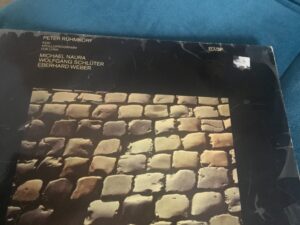
Peter Rühmkorf: Kein Apolloprogramm für Lyrik
100: Miles Davis: Jack JohnsonEine andere Wetterscheide
Mir ist klar, warum ich EIGENTLICH keine Liste meiner Alben der Siebziger machen kann, es wären dreihundert Langspielplatten. Und wie viele von ihnen enthielten lessons of life and love, die widerständig blieben, egal, welche Narrheiten über einen kamen. Das war die beste Sozialisation, oder, um es in einer alten Sprache auszudrücken, die beste Schule des Herzens. Und das Herz schlägt links, bingo! Was sonst wählen am kommenden Sonntag ausser Grün, Die Linken, oder SPD. Ich verachte die Leute, die aus eigenem Frust den Gang zur Wahl verweigern und somit die neuen Nazis stärken.

Und, jaja, es ist alles andere als purer Eskapismus, in meinem Plattenregal in einem lang vergangenen Jahrzehnt zu stöbern, und eines dieser ewigen, erschütternden, herzschmelzenden, melodietrunkenen, geschichtsbewussten, umwerfenden Songalben jener wilden Dekade aufzulegen (ich nenne es spasseshalber die Nummer 12 meiner Top 300), zum wievielten hundertsten Male eigentlich!? Da wird auch der Geist von Versailles gestreift, jene Konferenz der Mächtigen, die den Boden mitbereitete für die Schrecken, die dann noch kamen. „Paris 1919“ heisst das unfassbare, unerschöpfliche Album, das erstmal daherkommt wie eine Soft Rock-Platte unserer besten Jahre (kein böses Wort gegen den Zauber von Al Stewarts „Year Of The Cat“, my number 301), und dann, mit der Zeit, alle möglichen Geister und Gespenster zum Tanz bittet. Es ist mir eine dunkle Freude, in diesen Tagen Mark Doyles brandneues Buch über John Cales „Paris 1919“ zu lesen. Hier folge ich den Wegen von John Cales Kindheit in Wales, hin zu seinen Jahren in New York und Los Angeles. Mark Doyle hat zum Glück keine track-to-track analysis im Sinn, denn er kennt das Phänomen, dass bestimmte Alben einen ein Leben lang begleiten, und nicht aufhören, zu überraschen. Fragt mal Jan Reetze!
Und jetzt mache ich doch eine Liste.
My 100 most beloved albums in the 70‘s.Kein Apolloprogramm für Lyrik
Über die Jahre, nicht
weit versprengte, ein
stiller Nachhall, griffbereit
im ungeordneten Archiv,
als wäre er, und das ist er,
immer noch da.Wetterscheide
Mein grosser Held veröffentlichte 1986 einen Song namens „A Quiet Life“, und, bereits ein begnadeter Aussenseiter, als er seinen modeverrückten Bruder auf der Carbanby Street begleitete, sagen wir 1966, blieb er sich auch später treu in seinem Blick auf Elementares. Wir frühstücken gerade, und die beiden Mädels richten schon mal den Blick nach Malaga Ende April. Da ist natürlich Sonnenschein garantiert, so wie Regen in Wuppertal, bei mir ist die Lage nicht so klar. Habe alle meine Wetterprognosen für Lanzarote in den ersten sieben Tagen im März parallel geschaltet – ernüchternd. Dagegen ist das Wetter auf Sylt und Langeoog verlässlich kühl und wechselhaft. Und plötzlich landen wir bei Urlaubsgeschichten, die in den grossen Sommerferien im Norden der alten BRD immer auch Dünenschleichwege waren, Verliebtheiten, Kissenschlachten, Fahrradausflüge zur Meierei im Ostland, Wattwanderungen mit Würmern, Halmatage im Hotel, und morgendliche Spaziergänge zu den neuen Kinoplakaten mit Abstechern zum Kiosk. Und so deutet auch jetzt alles auf die Scholle „Finkenwerder Art“ statt auf Mojo rojo und Mojo verde. Einmal mit 14 und meinen Eltern in Westerland, Bilderbuchsommerwetter, Tag für Tag, auch Milchreis mit Zimt, der Wellengang aber recht zimperlich, und mir war seltsam langweilig, ein Urlaub ohne Schwärmerei, Lieblingsbücher, neue Freunde – der einzig magische Moment war im ersten Anflug ein mächtiger Schreck: der Kauf einer „Bravo“, mit entlarvenden Fotos, wie sich zwei meiner „heroes who never die“ auf der Bühne prügelten, sturztrunken. Der Kioskbesitzer hatte ein Transistorradio, und als ich den Artikel im Stehen verschlang, ertönte aus dem kleinen Lautsprecher und dem Schatten seiner Bude die vertraute, absteigende Basslinie von „Sunny Afternoon“, und die Welt war für ein paar Minuten unverwundbar.
„Here, there, and everywhere“ – some notes on „Luminal“, „Lateral“ etc.
Two albums.
Luminal is eleven songs, with vocals.
Lateral is one longer instrumental piece, around an hour long. (F.A.)
Four albums, from left to right: Keith Jarrett & Jack DeJohnette: Ruta and Daitya. A milestone of archaic grooves, with Jarrett playing electric keys for the last time in his life. I wish the two would have followed these paths untrodden. Luminal, an instant classic. Paul Bley: Open, to love. A stone cold classic. Lateral, another instant classic. Don‘t call it just another Eno ambient work, it is beyond compare and has a perfect second title: Big Empty Country. Imagine the wide open spaces of a Taylor Sheridan Neo-Western series, with an decent sense of longing, romance, loss of words, and no figures in the landscape. No kitsch, no Hollywood score, no violins from the sky. Just waves and waves and special colours. And then these acoustic guitar lines, ascetic as they are, like a Nashville Nirvana. Like the essence of a Hank Willams tune, suspended in air. Be careful, i am obviously writing nonsense, so I might be right. And the album closing the line of lifers: Ruta and Daitya again – decades later ECM decided to replace the cover. I always loved Maya Weber‘s painting, its dream space. I was 17 when I fell in love with the album. (M.E.)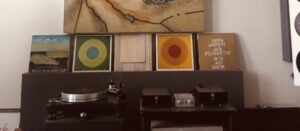
The content of these albums takes the burden of responsibility away from the listener. Meaning, the responsibility of trying to figure out who is playing what, or how it was recorded, all that information that tends to separate you from just listening. It’s all beautiful and dreamy. Inspired and inspiring. Useful/utilitarian. I hear synth sounds, but already that is saying too much. You can disappear into it, talk over it, play it over and over, or just listen to a bit of it and get back to the rest later. The notes that stand out as melodies sound purposeful in a way that makes me think that it’s not necessarily meant for meditation. Although I was driving while listening to Lateral, and maybe that could be described as meditative. It seems right for any type of location. I really think it can work anywhere, out of any kind of speakers.
I thought of a sketch idea while I was listening, where the people making this music were very unlike Beatie and Brian. Like, the opposite. But then I realized that those characters would also fit perfectly well in creating these albums. The music overrides whatever concept you might have of what the composers are like. By the way, who were you picturing in your head as the opposite?
Right now, I’m recalling the songs in my head pretty clearly. The sound of it all. I guess technically, that also makes it catchy. I hope it’s okay for me to use that word.
I’m going to put it on again right now. I’ll just start in the middle somewhere.
Fred Armisen
Well, Fred, as true as this may be in some ways at least, your statement comes down to: „Let the music speak for itself“. Not the favourite message for a music journalist. I was a bit working in the opposite direction when writing my questions on paper. And I think it is no real burden to go deeper into the music with some additionl food for thought and sensation. Maybe, in the end, my floating, ever so deep research will end up in my special series of „imaginary interviews“. Nevermind. Easily you will return (every once in a while) to the sounds and the words and the in-between.Michael Engelbrecht