He called it „a lifer“
The first person I ever heard the word „a lifer“ from, was Braveheart Ian McCartney, who spoke or better wrote about it in regards to a handful albums that became life‘s company or worth living a life with. A matter of the heart. Did he even mention it when Lajla an i met him for dinner in Glasgow in early 2016? It rang a bell, but why did i never stumble upon this word in album reviews, apart from the glory days of Manafonistas and the later years of Flowworker? Ian called Harold Budd‘s and Brian Eno‘s „The Plateaux Of Mirror“ „a lifer“, for example. He could listen to it endlessly, and, in fact, he returned to that album again and again. And to its successor, „The Pearl“. Same, but different. I agreed wholeheartedly with his passion for these albums and adopted the term. See my post from some days ago: „Five Lifers“. Nearly everybody is using it from our little group. Here comes another „lifer“:
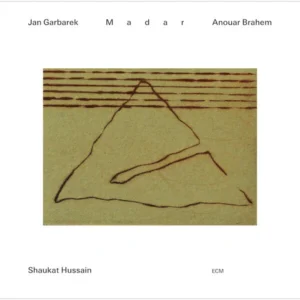
Speaking along with Jan Bang on encounters between Moroccon / North African traditions and sax players it is not far-fetched to think of another „killer album“ or should I say „lifer“„The Trance of Seven Colors“ by Mahmoud Ghania’s ensemble feat. Pharoah Sanders (produced by Bill Laswell, and recorded in 1994 in Essauouira (!)), or, in its spiritual neighborhood, Jan Garbarek‘s album with Tunesian oud master Anouar Brahem „Madar“, an album that became „a lifer“ for me since its ECM vinyl reissue. The album has everything Robert Wyatt is speking about „the breathing thing“ that music has to emulate, if it‘s striving to surivive season and style.
Ian McCartney hat mit „A Lifer“ eine neue Bedeutung und Konnotation geschaffen, so seltsam einleuchtend, dass wir sie hier all übenommen haben. im allgemeinen Sprachgebrauch bezeichnet ein „lifer“ meist eine Person, die zu lebenslanger Haft verurteilt wurde, und, je nach Kontext, können andere semantische Ebenen mitschwingen: ein „lifer“ ist der erste Vogel einer bestimmten Art, den ein Beobachter in seinem Leben jemals in freier Wildbahn gesehen hat. In den USA wird ein lebenslanger Berufssoldat gerne „a lifer“ genannt. Gelegentlich wird der Ausdruck scherzhaft für Personen verwendet, die sich überdurchschnittlich stark in ein Thema, ein Spiel, oder eine Subkultur vertiefen, also auf Personen, die einen Narren an etwas gefressen haben. Aber eine Langspielplatte, der man sich absolut verschrieben hat, „a lifer“ zu nennen, hat es vor Ians Eingebung des Augenblicks schlichtweg nie gegeben. Eine dezente Verschiebung, ein sprachlicher side-step.

Coming back to „Madar“. When it was released in 1994, i Iiked it from start on, but i think I made the mistake to never play it loud. Now, when only slightly turning up the volume, you realize the extreme dynamics of the Oslo recording session: some passages are so quiet you can hear the famous needles fall, the grass grow, the horizon sigh (overtly poetic, but i want to light your fire, too) – other passages are making your walls tumble, your belly shake, all the while the sound is crystal clear. An immaculate digital, yes, digital, high end production that is on par with three musicians, a tone engineer, and a producer „at the peak of their powers“, to use a more frequently used phrase. What else can I say. It‘s a lifer! There‘s a jukebox in heaven that plays that stuff all night long.
5 Kommentare
Jan Bang
Five More Lifers
These albums are the ones that I keep coming back to. Some have stayed with me since childhood: I bought One Trick Pony at 12. Others came along the way. My mother played the Brahms intermezzi on the piano and often put on the Glen Gould LP ON summer evenings. She would play it loud with the door to the veranda wide open. At Christmas we always listened to the Jack Jones Christmas Album. Still do.
I discovered Branko Mataja album from 1974 entitled Traditional and Folk Songs of Czechoslovakia in a Rough Trade store on Brick Lane playing over the speakers. What a beautiful album of highly personal takes on traditional songs from o”former Czechoslovakia. A holocaust survivor who migrated to the US after the war and made home recordings of treated guitar overdubs.
The Gal Costa/ Caetano Veloso Domingo album was given to me as a present by, Sylvian’s artistic partner, Yuka Fujii. It made perfectly sense to me that this specific album perhaps was the inspiration for Secrets of the Beehive, another lifer I used to listen to endlessly, that I unfortunately cannot listen to anymore. So I guess that is off the list.
The five Eno Lifers albums are unsurprisingly the same as yours, Michael.
Being Hybrid, The Pearl, Apollo, On Land and Voices All are music for night creatures.
With that set aside, the final album on the Lifers list is yet another Eno collaboration. The masterpiece with Jon Hassell – Possible Musics. Music for angels.
Glenn Gould – Brahms Intermezzi
Branko Mataja – Traditional and Folk Songs of Czechoslovakia
Paul Simon – One Trick Pony
Gal Costa / Caetano Veloso – Domingo
Hassell / Eno – Possible Musics
Bubbling under:
Bootsy’s Rubber Band: this boot is made for funkin’
Hamlet Gonashvili (self titles)
John Coltrane / Johnny Hartman
Michel legrand and his orchestra: I love Paris
Syreeta (self titled)
Pascal Rogé: 3 Gymnopediés
Nick Drake: Five leaves left
Scott Walker: Scott4
JB
Michael Engelbrecht
Branko Mataja, interesting. A new name for me.
Here my Sylvian story, and who can confirm it, if not the live samplist from Kristiansand!? 😉
It’s hearsay, not waterproof, but this is what I read. In the end times of Japan, David Sylvian listened to Scott Walker’s TILT, and he stopped in the tracks. Deep listenung of TILT became an essential experience of creating BRILLIANT TREES. True? Listening to both albums, it makes sense for me.
Fact is. Eno and Lanois were thrilled by TILT, too, and they knocked on Scott’s door. They wanted to produce his next album. Scott didn’t like the hippie attitude of Dan Lanois. End of story.
The thing with lifers is: now, before my last radio show, I sell hundred and hundreds and hundreds of albums, albums of high class, too, even holy grails. I will only keep my lifers, everything else will be gone with the wind.
P.S. Today, on my way to Rursee, swimming, lying on the grass, dreaming, I heard the whole Jack Jones Christmas Album (via youtube, and i KNOW that these old sounds can establish a strong bond with the spirit of our childhood) ….
P.P.S. The deepest Coltrane cut: In the August edition two reissues get 10/10 from Uncut, and for all the good reasons: John Coltrane’s Ascension and Arvo Pärt’s Alina. That said, i have my favourite Coltrane Free Jazz albums, but his first radical free jazz statement ASCENSION never came close to my heart. Nevertheless, I lost my heart for the IMPULSE triple album: CONCERT FROM JAPAN, six sides of making the walls come.tumbling down by Coltrane, Sanders, Alice, Rashied, Jimmy. Oh, my god.
And my ultimate lifer of Mr. Cotrane became, apart from A LOVE SUPREME, CRESCENT!
Loves that BALLADS album, too. Bobo Stenson had a mini sartori, kind of, while listening to BALLADS during a boat party.
Michael Engelbrecht
Mark Hollis and Talk Talk all around these days.
ARVO PÄRT
Alina (reissue, 1999)
10/10
ECM
10/10 Immaculate recordings of Estonian’s masterpieces finally issued on vinyl “It is enough when a single note is beautifully played,” Arvo Pärt, now 90, once said, predicting Mark Hollis’s remark around Laughing Stock that he’d “rather hear one note than I would two”. Few composers have made a greater impression on contemporary artists, from Thom Yorke to Björk to Michael Stipe, who praised Pärt’s “infinite calm”, and this 1995 recording, released four years later, presents interpretations of two crucial works. Showcasing the minimalist style Pärt termed tintinnabuli, pianist Alexander Malter performs two meditative, 10-minute renditions of 1976’s “Für Alina”, selected by the composer from a seven-hour improvisation around his two-page score. Remarkably, their lucid purity is eclipsed by 1978’s serene “Spiegel Im Spiegel”, its arresting blend of heartrending cello or violin melodies – there are three versions here – and pianist Sergej Bezrodny’s hauntingly measured arpeggios enough to stop time itself.
WYNDHAM WALLACE
Jan Bang
Dear Michael,
I assume you mean Blemish? (not Brilliant trees that came in -84)? Oh I’m sure it was a huge inspiration. This is how most artist work. Identity is not singular. We’re all culturally mixed. Different people create different results. Both Tilt and Blemish are statements in a time of changes. (Brytningstid in Norwegian)
I feel a strong connection with Estonian music. The traditional „Rune“ music was key to the development of my late friend, choral composer Veljo Tormis. Alina is one of the masterpieces from Pärt that also include Solfeggio and Cantus (in memory of BB).
I can understand why Walker abandoned the proposal from che Lanois. He was moving away from the romantic ideal and into the abyss. Til couldn’t possibly have been made with anyone else than the working musicians available to Walker at that time. Reminder: keep to the original vision ( David Lynch).
Michael Engelbrecht
I was wrongfooted. Timewise. In fact I meant TILT (in my memory it came out out in the early 1980’s… this happens to timeless music, it can pop up from everywhere in the time continuum😉
I agress with that polarity of romantic ideal vs. the abyss. The story with imaginary albums ….
And FORGOTTEN PEOPLES by Veljo Tormis is a buried treasure from the ECM archives. I love my old vinyl from 1992.