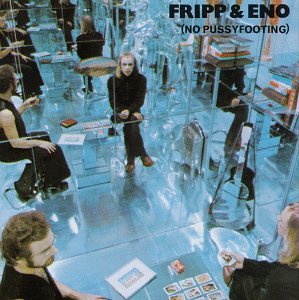
No Pussyfooting (for Mikal Gilmore who once opened me up for „the idea of passivity“)
“the most enjoyable pop electronics since Terry Riley’s A Rainbow in Curved Air and that it was…more visionary and more romantic than James Taylor could dream of being.”
Zwar liebte ich dieses erste Frippertronics-Album vom ersten Tag an, als ich es zu hören bekam, aber das dauerte bis zum Winter 1975! Da ich mich, alter Hut, nie begeistern konnte für die ersten zwei Roxy Music-Alben, fiel Eno erst mal hinten runter, und dann schrieb noch der geschätzte Manfred Sack in der ZEIT einen bösen Verriss über No Pussyfooting, in Richtung eines drogenvernebelten „Klaus“ der „minimal music“. Aber alles kam, wie es kommen musste, als ich innnerhalb weniger Wochen „Taking Tiger Mountain“, „Evening Star“, „No Pussyfooting“ „Discreet Music“, und „Here Come The Warm Jets“ erstand. Mein persönliches Shangrila im Winter 1975. Es gab noch eine Welt nach den Kinks und den Beatles. Meine ersten fünf Eno-Platten, und alle gingen durch die Decke in meinem Würzburger Studentenwohnheim. Einzige Ausnahme war Seite 1 von „Evening Star“, namens „Index Of Metals“. Damit wurde ich nie warm.
Manfred Sack war übrigens wichtiger Multiplikator der frühen ECM-Jahre, allein den rhapsodischen Stil von Keith Jarretts Soloalben mochte er nicht. Ich habe so gut wie alle Frauen in meinem Leben nehr oder weniger verrückt gemacht mit meiner Liebe zu Brians Musik. Manche mochten ihn aber auch, früher oder später. Nach wie vor krieche ich in die beiden langen Stücke von No Pussyfooting hinein, die Klänge beglücken mich, ich habe sie nie rein historisch oder analytisch gehört. Ob „Swastika Girls“ oder „The Heavenly Music Corporation“.
Natürlich, nach so langer Zeit, bildet sich eine feine nostalgische Patina, wie bei alten Teekannen, aber die Faszination bleibt unangestastet. Wie bei dem ersten This Heat-Album. Wie bei „Low“. Wie bei „Marquee Moon“. Wie bei „Time Fades Away“. Wie bei „Chairs Missing“.
When Eno in, I think, July 1972, said, “Would you like to plug in?” without explaining how his tape setup worked, he gave me the technical means to build layered sound – emulating, if you like, a string quartet [with the fuzz].
Along with Eno, you’re one of a small cadre of cult English eccentrics – people you’ve often worked with, such as Robert Wyatt, Peter Hammill, David Sylvian…
You’re putting me in good company there.
…even Peter Gabriel, though I guess he’s on a different level, commercially.
Peter Gabriel is one of the industry’s genuine good guys. And I have a deep, abiding and ongoing respect for Robert Wyatt. I think one of the reasons I was asked to produce Matching Mole’s Little Red Record is that Robert was too good and generous a person to be able to take that role on himself, a role which fell to me in King Crimson, which is one of the reasons I have a terrible reputation in the industry. I believe I was never paid for producing that, but you don’t work with Robert to earn a living, you work to be in Robert’s creative space. Similarly with Eno. [Label and management] EG acted to prevent [1973’s] (No Pussyfooting) from having a major release at the time as they felt working with this leftfield character, Fripp, would handicap Eno’s chance of having a commercially successful career. However, David Bowie listened to it – maybe Iggy Pop mentioned it to him, as I was told that Iggy could whistle all the main themes to (No Pussyfooting). When Bowie invited Eno to Berlin for Low, I later heard that he was interested in inviting me too, but I was in retreat at Sherborne House, and I didn’t get the call until July 1977. I think my best work as a guitarist has been mainly with Eno and Bowie.
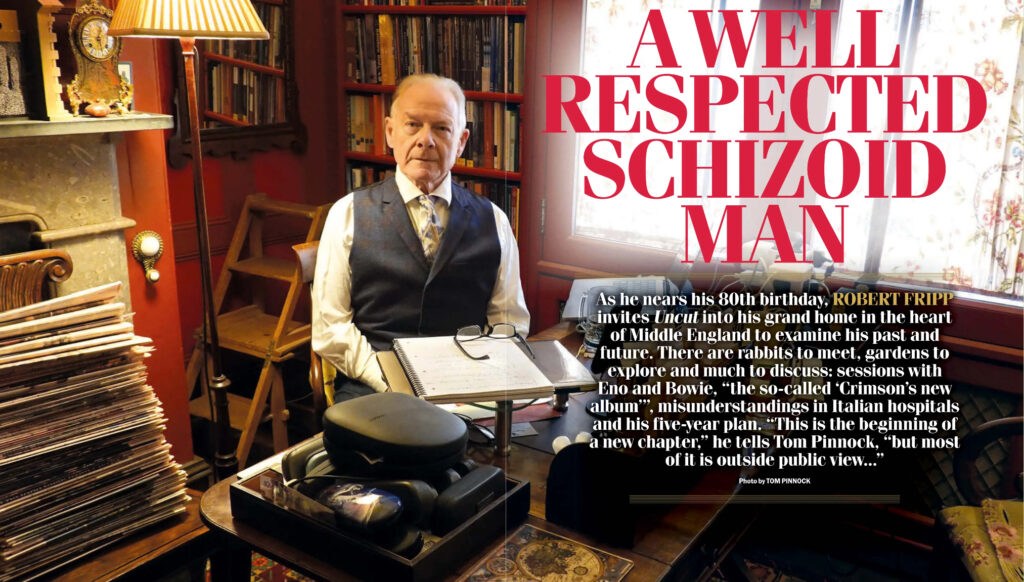
HERE a flowie „waterfally“ interview from 1998 with Robert sharing my questions with wonderful lad Michael Frank. The long quote is taken from an extended interview with Fripp from the July edition of Uncut. i loved No Pussyfooting from day one!
Ein Kommentar
Mikal Gilmore
Around the same time that I’d gotten back with Violetta, Neil Young was midway through his best series of albums—sometimes roughhewn, sometimes crestfallen, always carrying a rage about the times: Time Fades Away, On the Beach, Tonight’s the Night and Zuma. (The first three are often viewed as a trilogy, but for me Zuma rounded it all off into a doom quartet.) These albums were often rough going for those who had fallen in love with Young for the allure of 1972 Harvest, though “The Needle and the Damage Done” had shown that his mellifluence was starting to say different things.
I’d say to friends, “You have to hear this new Neil Young album…” and they were already grabbing their car keys. One said to me, “You are not playing that album for me in my own home, not after that fucking Time Fades Away.” When I pointed out to this friend that he was sitting in my front room—and not in his own home—the reply was, “It’s the principle.”
(From his newly discovered Substack Site)