A Sonic Fever Dream: 25 Years of Drawn from Life by Brian Eno and J.Peter Schwalm – by Markus Reuter
Sometimes the memory of when and how a certain album found its way
into your life begins to blur. In the case of Drawn from Life by Brian
Eno and J. Peter Schwalm, I no longer recall the exact circumstances
under which I acquired the record back then. Of one thing, however, I
am certain: I had long been a great admirer of Eno’s work, from albums
like Nerve Net and The Shutov Assembly all the way to the later
release Another Day on Earth. Yet Drawn from Life holds an absolute
special status for me. Not only is it my favorite work in Brian Eno’s
extensive catalog, it also ranks among my personal top ten albums of
all time. Quite simply, it is the perfect music for conjuring a truly
magical mood.
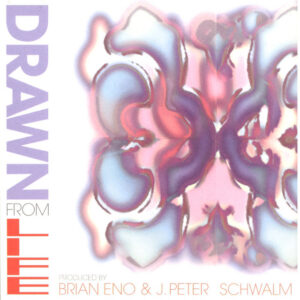
Now, in 2026, exactly a quarter of a century after its initial release
in 2001, this masterpiece is finally receiving a reissue, complete
with new artwork. Admittedly, I was very fond of the original cover,
even if a few of my graphic designer friends found it downright awful
for reasons that completely escape me. To my mind, the visual and
acoustic package fit together seamlessly right from the start.
A Seamless Fever Dream
What makes this album so extraordinary is its specific, almost
weightless character. It is most aptly described as a musical fever
dream: a state in which you lose all temporal and spatial orientation,
no longer able to tell where you are, where it begins, or where it
ends. The entire work feels deeply conceptual and cut from a single
cloth.
With music this process-oriented, it is often nearly impossible in
retrospect to assign exact compositional credit. Who actually did what
here? Because the creation of such pieces thrives on countless small
steps, happy accidents, and extensive post-production, traditional
notions of authorship dissolve. Nevertheless, it is obvious that this
album is not merely an Eno solo statement, but a genuine, equal
artistic symbiosis with J. Peter Schwalm.
From my own practice with this kind of music, and not least through my
collaboration with Peter on our joint album Aufbruch, I am intimately
familiar with his working methods and can tangibly feel how immense
his contribution is here. In every second, you can hear the extreme
meticulousness with which he shaped the arrangement and sonic
aesthetic: how he repeatedly pieced together countless fragments,
dynamically mixed them, discarded them, and layered them anew. His
perspective is aimed entirely at atmosphere and density, emancipating
itself completely from traditional musical parameters. On this purely
sound-painting level, Eno and Schwalm found true kindred spirits in
one another. Incidentally, for anyone wishing to dive deeper into
Peter’s sonic cosmos, I wholeheartedly recommend his deeply rewarding
work with trumpeter Arve Henriksen.
Sonic Architecture, Dub, and Harmonic Friction
The entire production is defined by a striking sense of space. This
applies not only to its immense depth of field, but also to the
razor-sharp stereo image, in which even the most delicate detail
occupies its precisely defined place. A distinct dub aesthetic comes
into play here: spaces themselves become instruments, sounds emerge
out of nowhere and dissipate into endless reverb tails, supported by
exquisitely tasteful filter effects that allow the frequency spectrum
to breathe organically.
Woven into this spatial tapestry are electric pianos and acoustic
piano, contrasted by the dramatic, almost cinematic use of orchestral
percussion, including timpani.
In isolated moments, augmented and diminished intervals, or sharp and
flat intervals, rub against one another in a floating mixture across
different degrees of the scale. Despite this carefully dosed harmonic
friction, the music glides along completely effortlessly.
Between the Organic and the Artificial: Details in the Soundstage
The album’s special emotional warmth comes from the delicate interplay
of the featured guest musicians and the seamless fusion of organic and
artificial sounds. On violin and viola, Nell Catchpole delivers
wonderful string passages that, while heavily processed
electronically, contribute essentially to the underlying mood and
melodic framing. Leo Abrahams contributes his characteristically
subtle, delicate guitar textures, while Laurie Anderson lends her
unmistakable spoken-word voice to “Like Pictures Part 2.”
On the track “Two Voices,” in turn, we hear Brian Eno’s own voice
processed through one of his signature vocoder effects. In this track
in particular, the organic and the artificial form a fascinating
union. In “Two Voices,” I even believe I can pick out the very
specific sounds of a digital Roland guitar synthesizer. These are the
exact same timbres that are also present on the later 2004 Fripp/Eno
album The Equatorial Stars. This soundstage is complemented by unusual
textures such as Holger Czukay’s dictaphone recordings, percussion by
Heiko Himmighoffen, and the children’s voices of Eno’s daughters,
Darla and Irial, on the track “Bloom.”
“Bloom,” in particular, pushes the album’s trance-like quality to its
peak with its hypnotic shuffle groove. Interestingly, the album is
also threaded with deeply aesthetic bass motifs that sound strikingly
like an organically played bass guitar, though no explicit credit for
them can be found anywhere in the liner notes.
Musical Kinships: From Erik Satie via Klaus Schulze to Hector Zazou
When you trace the contours of this album more deeply, lines of
connection to other great sonic architects immediately open up in the
mind. On the one hand, there are the wonderful works of Hector Zazou,
whom I also hold in high regard and who often built a similar bridge
between organic instruments, human voices, and electronic poetry. And,
of course, a direct line leads back to Erik Satie, the true forefather
of ambient music.
Upon recent, intensive re-listening, however, another unexpected
parallel dawned on me: a remarkably similar atmospheric density exists
on a much older work, namely Klaus Schulze’s 1978 masterpiece X. On X,
one finds those monumental pieces featuring a string orchestra, analog
synthesizers, and the live drumming of Harald Großkopf, particularly
his distinctive tom-toms drenched in deep reverb. Although Drawn from
Life was not released until 2001, it unmistakably breathes the spirit
of the 1970s through this exact combination of orchestral textures,
deep percussion sounds, and electronic vastness. To anyone who loves
Drawn from Life, I warmly recommend Schulze’s X.
For me, Drawn from Life remains a timeless sonic mystery. A truly
wonderful album that, even after a quarter of a century, has lost
absolutely none of its original magic.
Ein Kommentar
Michael E
Another very fine entry into the world of Drawn From Life, Markus. In 2001 one could count those really interesting reviews on the fingers of one hand. But, now, within short time, great echoes from Leah Kardos, the guys from Uncut and Mojo, and other places – like flowworker.
I always found the original cover quite okay emphasizing details, accidents, chance operations – and mirroring that irresistible transparency of it all. Even the drumming was never down to deep earth, much more mood and colouring than time-keeping. Or time-cutting. The drumming parts are essential for DFL, like Nell’s violin playing that I loved from start on when she appeared in Brian’s world.
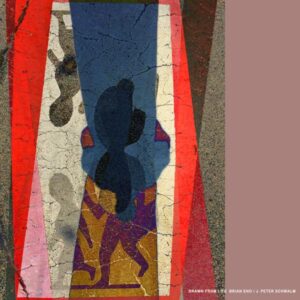
But the new cover is a real improvement in my eyes. it brings up – in a very attractive way – the „human element“, my first thoughts: apparitions of humans in quite seductive surroundings.
And the colours have more impact.
They make me ask: what is behind the curtain? 😉
Strange enough I even start to like Two Voices now more and more, a track my minor quibbles were reserved for on the fantastic journey DFL is.
And, that „bonus track“, „Bloom (instrumental), for me it is much more than a bonus, it is the perfect closer of the album. The whole composition is a strange kind of „Ohrwurm“, or better said, it can never start to bore me, and it is a thrill of its own to listen to the instrumental version in the end.
Same but different, very different!, without the underlying voices…