Michael’s final radio hour
Deutschlandfunk, September 24
Listen to „Klanghorizonte“
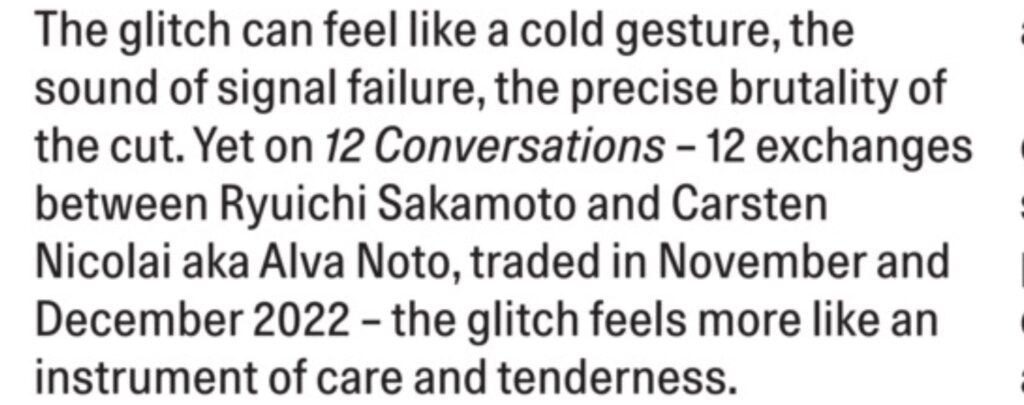
Playlist of „Klanghorizonte“ with a nearly seamless sequence, in regards to storytelling, dream logic, old and new interviews of mine, – and different horizons track by track… (words on „12 Conversations“ by Leah Kardos (The Wire)
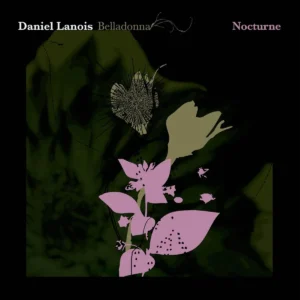
FIRST HALF („Nocturnal Green“): Brian Eno: Music For Films (1978) / Robert Wyatt talking / Robert Wyatt: Cuckooland (2003) / Ryuichi Sakamoto & Alva Noto: 12 Conversations (2026) / Annette Peacock (from an old interview) / Annette Peacock: An Acrobat‘s Heart* (2000) / Daniel Lanois: Belladonna Nocturne (2026, 2 tracks) / Daniel Lanois talking in between / Lambchop: Punching The Clown (2026)
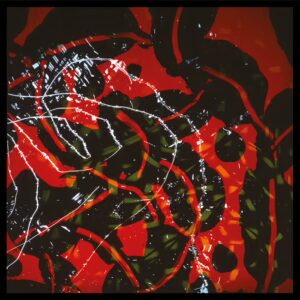
SECOND HALF (Red Sports Car in L.A.): Seefeel: Sol.Hz (2026) / Laurie Anderson talking / Laurie Anderson: Bright Red (1994)** / Jana Winderen: Spring Bloom at the Marginal Ice Zone (2017) / Jana Winderen (from an old interview, inside the music)*** / Brian Eno talking (the story of „Fractal Zoom“) / Brian Eno: Nerve Net (1992)
*“Unsung Heroine“ (short documentary)
**“We’d look out at the river, and if the music seemed to be naturally going with it, this was our editing device. Brian’s motto was: if it goes with the river, it goes on the record. So, for example, if the river was really choppy and active, and the music was going pah-bah-dah-dah – whoa, that looks so great! – or if it was smooth and there was some kind of ambient thing going on. We always tried to match – tried to feel – the naturalness of the river, and in this case the Hudson, and if it seemed to fit. It was a very infallible rule while recording „Bright Red“ in Manhattan, because it showed you when you were making it too difficult, not natural.“ (laurie anderson)
***Nearly everybody has a story to tell with „field recordings“, that will always trigger the knowledge about some of the most adventurous sounds being „out there“. Some of those albums became famous, some very much stayed under the radar (very much like the spaces they had been exploring). Even the so-called well-known can easily turn into stranger things. By chance, I once discovered an old album named „Trains in the Night“ beautifully capturing the sounds of old locomotives in England‘s vast hinterland, and the nature around. Listening to the compositions of artists like Jana Winderen or BJ Nilsen, is always a special experience. Is the howling of the wind real, or enhanced by electronics? How can someone „document“ sounds that cannot be be heard within our „normal“ range of perception? In a way the act of „cartographing“ distant areas includes sharpened senses, adequate tools – and inventiveness. When I was sinking, literally, into the „music“ of Jana‘s „arctic“ record, I couldn‘t help but remember, in moments passing by, old sci-fi movies and books, but from minute to minute I was more and more drawn into the sounds themselves and forgetting my sepia-tinged nostalgia. Where-am-I-music of a rare kind. Like all of the albums of this hour! (michael engelbrecht)
“Belladonna Nocturne“
Die vierzehn originalen Kompositionen kommen allesamt, wie der Titel suggeriert, als Nachtstücke daher, aber wer sagt, das sie durchweg besänftigen!? Besser niemand. Auch sollte man bestimmten Begrifflichkeiten nicht trauen, die immerzu aus dem Köcher gezogen werden, wenn der berühmte Produzent und Musiker ein Instrumentalalbum veröffentlicht: „Ambient“, oder, die jüngste Mode, „Ambient Americana“. Das sind durchweg Verengungen des Blicks, Floskeln, die alles, was Klang ist, runterbrechen, auf eine meditative Affäre, Beruhigung. Es geht so ganz anders zu auf „Belladonna Nocturne“, und das ist nicht allein den Schlagwerkwirbeln und variablen Metren von Brian Blade geschuldet: jede einzelne Komposition ist eine dramaturgisch vielstimmige, mindestens doppelbödige Veranstaltung, gesegnet mit Stolperfallen, Einrissen, Brüchen, Lichtungen, Brandungen, und unberechenbaren Schattierungen. Vermeiden wir bitte das Wort „atmosphärisch“! Diese konzentrierte Ware mal galant vorbeirauschen lassen, wäre ein Irrtum und ein wenig anstrengend. Es empfiehlt sich, dem Raum zu verdunkeln, die Sinne zu schärfen, und auf Reisen zu gehen mit vierzehn Short Stories, die eher an Raymond Carver erinnern als an einen Soundtrack für entspannte Gemütslagen. Unglaublich, dieses Album!

The 14 original compositions are all, as the title suggests, presented as “night pieces,” but who says they’re all soothing!? Better not to say so. Nor should one trust certain terms that are constantly trotted out whenever this famous producer and musician releases an instrumental album: “ambient,” or, the latest trend, “Ambient Americana.” These are, without exception, narrow-minded labels—clichés that reduce everything that is sound to a meditative experience, to calmness. Things are quite different on “Belladonna Nocturne,” and that’s not solely due to Brian Blade’s drumming flourishes and variable meters: every single composition is a dramaturgically polyphonic, at the very least ambiguous experience, blessed with pitfalls, insights, breaks, clearings, surges, and unpredictable nuances. Let’s please avoid the word “atmospheric”! To let this concentrated work simply rush by gracefully would be a mistake and a bit exhausting. It’s best to dim the lights, sharpen your senses, and set off on a journey with fourteen short stories that are more reminiscent of Raymond Carver than a soundtrack for relaxed moods. This album is incredible!
Dunstküste
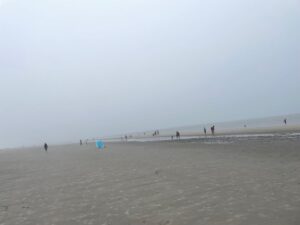
Während der grösste Teil von Deutschland schwitzt, liegt über Teilen der ostfriesischen Inseln ein Hochnebel, oder nennt man es Wolkendunst. Die Sonne versucht vergeblich, ein Loch in die Wolken zu brennen, auf 17, 18 Grad hat sich alles nah der Windstille eingegroovt. Auch nachts. So gibt es keinen idealen Strandtag, aber meditatives Verweilen in all den Dingen, die ich schon mit acht Jahren auf der Insel anstellte, ein talentierter Brötchenholer schon damals! Hin mit dem Fahrrad zur Meierei im Ostland (aus den Bonanza- Und Hollandrädern sind E-Bikes geworden), vorbei an der Melkhörndüne (die natürlich jedesmal bestiegen werden will, die Fernrohre an Aussichtspunkten sind rarer geworden), dann über den Deich zum Fährhafen (in den Cafés seit eh und je die Dominanz des Rührteiges), der Besuch in der Buchhandlung Krebs, der ewige Wasserturm auf dem Strandweg, die kleinen Unterhaltungen mit Strandkorbnachbarn.
Wie die Welt, und auch die Erinnerungen sich wandeln, wenn ich unterwegs Daniel Lanois‘ „Belladonna (Nocturne)“ höre – und ich höre nichts anderes! Da kommt eine besondere Art von Wehmut auf, manchmal der berühmte Schauer von Wirbel zu Wirbel. Mittlerweile ist ja „Ambient Americana“ ein Sub-Genre der Ambient Music geworden, und Lanois zählt mit seinen Arbeiten aus den 1980er Jahre zu den Pionieren, doch „Belladonna Nocturne“ ist alles andere als selige Rückschau (auch wenn ein Track „Early Days“ heisst). Call it multi-dimensional! Eine sanfte archaische Wucht öffnet den Raum über Inselhorizonte hinaus, verlangsamt den Blick, Nachtschattenhaftes bricht aus mit Brian Blades Schlagwerk. Eine seltsam irrationale Euphorie, die viel Fernes nah heranzoomt, Träumerei, altes Schweben, Gasthöfe der Kindheit, Stille bis zum Festland, und, nach Jahrzehnten endlich mal wieder, einen Becher Milchreis mit Zimt und Zucker! Schon jetzt ist „Belladonna Nocturne“ eines meiner Lieblingsalben des Jahres.