Brian Eno & Peter Schwalm: Drawn From Life (2001) / Brian Eno: Another Day On Earth (2005)

Beide Alben entstanden in einem kleinen Raum in West-London. Der Raum hatte keine Fenster, und seine Innenwände waren mit etwas verkleidet, das man, glaube ich, „Pegboard“ nennt – jenes weiche, matte, faserige Material, an dem man leicht Dinge befestigen kann. Es hat eine gelbbraune Farbe – wie ein Manila-Umschlag –, was sich als angenehme Farbe zum Arbeiten herausstellte. Es ist, als wäre man in Honig. Außerdem dämpft es interne Reflexionen, sodass der Raum klanglich relativ trocken und kompakt wirkt. Zunächst dachte ich, das Fehlen von natürlichem Licht im Raum könnte bedrückend wirken, aber tatsächlich hatte es den gegenteiligen Effekt: Ich konnte dort jede Art von Licht haben, die ich wollte (abgesehen von natürlichem Licht!).
Ich stellte fest, dass ich am liebsten in bernsteinfarbenem Licht arbeitete, insbesondere mit Lee-Filtern Nr. 156: Chocolate Brown. Das Fehlen eines Fensters war auch in anderer Hinsicht befreiend. Vor mir lag beim Arbeiten kein Blick aus dem Fenster, sondern eine riesige Weltkarte aus acht Tafeln, die zusammengesetzt eine Wandverkleidung von etwa zehn Fuß Breite und sechs Fuß Tiefe bildeten. Da der größte Teil des Planeten von Ozeanen bedeckt ist, hatte der Raum zusätzlich zum honigfarbenen Schimmer der Pinnwand eine sanfte bläuliche Ausstrahlung. Manchmal, während ich arbeitete, stellte ich mir vor, ich würde den Klang eines der Orte auf der Karte erschaffen: die Beringstraße; Kyzyl; das Korallenmeer; Pantelleria; Nowaja Semlja. Mir war bewusst, dass es mir darauf ankam, klangliche „Orte“ zu erschaffen …
(Brian Eno, 2026, the whole essay can be found on „Enoshop“ – and below!)
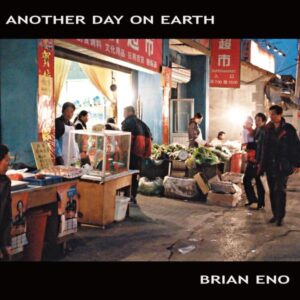
Both these albums were made in a small room in West London. The room was windowless, and its interior surfaces were covered with what I think is called pegboard, that soft dull fibrous material that you can easily pin things to. It’s buff-coloured – like a manila envelope – which turns out to be a nice colour to work within. It’s like being in honey. It also softens internal reflections so the room is relatively dry and compact sonically. At first I thought the absence of any natural light in the room might become oppressive, but actually it had the opposite effect: I could have whatever kind of light I wanted in there (aside from natural light!).
I found I preferred working in amber light, specifically Lee Filters #156: Chocolate Brown. The absence of a window was liberating in another way too. Facing me when I was working was not a view out of a window but a huge map of the world in eight panels that joined together to make a wall covering about ten feet across and six feet deep. Since most of the planet is covered by ocean the room had, in addition to the honey glow of the pinboard, a soft bluish presence. Sometimes when I was working I found myself imagining I was making the sound of one of the places on the map: the Bering Strait; Kyzyl; the Coral Sea; Pantelleria; Novaya Zemlya. I was aware that making sonic ‘places’ was what mattered to me…
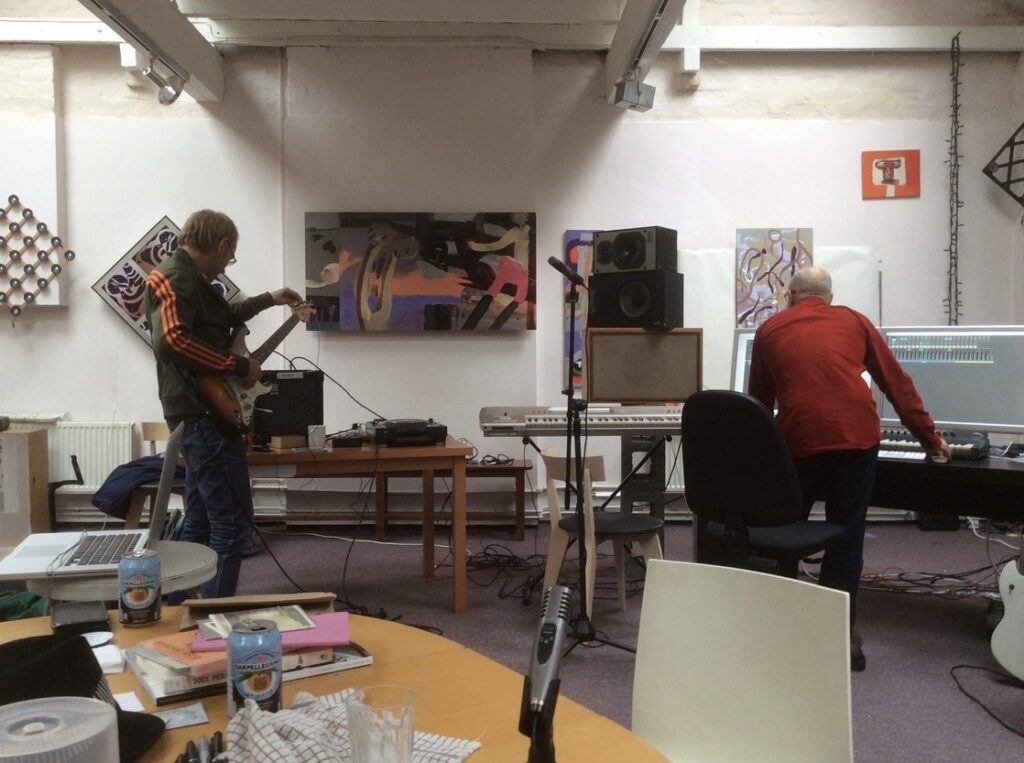
I was thinking not so much of making music but rather of evoking ‘the feeling of a place’ through sound. So as soon as I started to feel physical qualities like warmth or coldness or darkness or brightness or turbulence or calmness – as soon as that happened I felt I was onto something. Both these albums were made in this ‘landscape painting’ period. I had been thinking a lot about the difference between ‘Music’ as it was understood historically and whatever it was that we studio composers were doing now – let’s call it for now ‘Music 2’.
I know it’s a crap name. The differences were very striking: traditionally Music was ephemeral, fixed in one point in space and one point in time. It all had to be made at the same time – a performance – and to hear it you had to go to wherever it happened to be. None of those things were true for Music 2. Making Music 2 is much more like painting than like traditional composing. It’s not fixed in time: you can do it over an extended period, stopping and returning when you need to.
It’s not fixed in space: once made it can be heard wherever you choose to take it. Most importantly perhaps it’s available to be heard as many times as you want to listen to it. All of these features are characteristic of painting and the visual arts, not music and the temporal arts. At that time my primary instruments were the DX7 synthesiser – I had by this time collected seven of them, some modified to be able to do special things – and my Fernandes Guitar, made in Japan with electronics copied from a Fender Stratocaster (copied so faithfully that Fender reputedly managed to get a shipment of them destroyed for infringing their copyright). I also had a wonderful fretless bass guitar, which really should’ve ended up in the hands of a better player than me: an Ampeg from the 1960s boasting a scrollhead just like an acoustic double bass. I also had my Omnichord (the untouchable OM-300 model) and a Melodica that Holger Czukay of Can had given me. And there was a box of percussion and noise instruments including a set of temple bowls that Haruomi Hosono from Yellow Magic Orchestra gave me in 1989. So I was working with a fairly restricted palette, and I was happy with that.
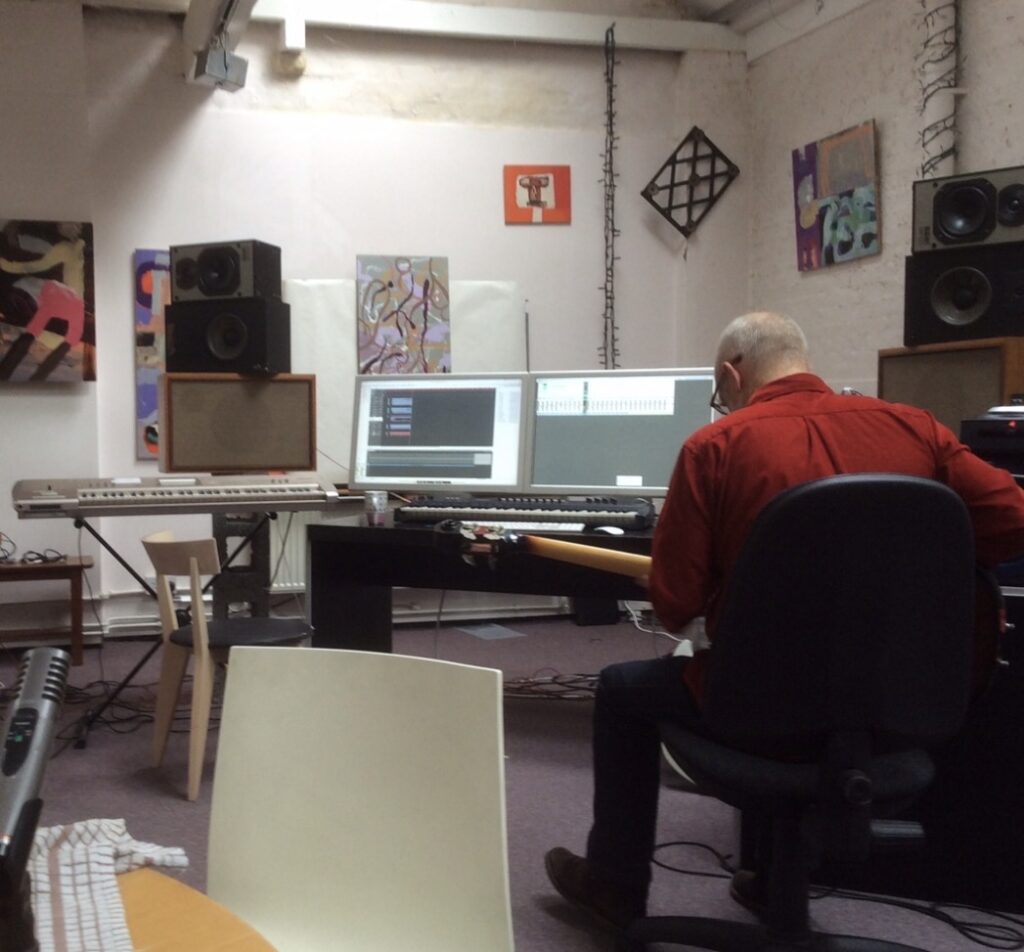
I still use all these instruments today except for the DX7, which has been superseded by the Native Instruments FM8 and various other software synths. The DX7 was probably the most successful synthesiser ever made – over 200,000 of them were sold. It was a complete pig to program since you had to do everything through a tiny window display involving menus within menus within menus. Hardly anybody bothered learning how to do it, relying instead on the provided internal programs that the instrument shipped with. I remember talking to a Yamaha salesperson who was surprised that more than 80% of DX7s returned for servicing had never been reprogrammed – they were exactly as they’d left the factory. He saw this as a failure of imagination on the part of the users.
I saw it as a failure of the design itself that it didn’t encourage reprogramming. Synthesizers of that era were made by people who apparently didn’t use them to make music. Some of the design faults would have been very simple to fix – for instance a simple overall ‘tone control’ such as a low pass filter on the output would have made the instrument so much more usable. Even the cheapest electric guitar has a ‘tone control’ which allows you to brighten or darken the sound. Some musicians enjoy, and can handle, having thousands of choices ready for them.
I prefer having fewer choices, or deliberately limiting the number before I start working. I think this is because I often begin making a piece of music by finding a sound-world. For me music almost always starts (and sometimes ends) with sound itself rather than with melody or rhythm, so I often begin a little like a painter who starts work by making a coloured wash over the canvas and then proceeding from there. I still work this way. I can happily spend an hour or two sculpting a sound before I even begin to ‘do anything’ with it. It’s in the process of inventing the sound that I start discovering what I’m doing, what ‘feelings landscape’ (gefuhlslandschaft) I’m entering. I think this upside down way of working – from background to foreground, and sometimes not ever getting to the foreground – comes from starting life as a painter, with a particular interest in 20th century abstraction from Wassily Kandinsky and Paul Klee to Frank Stella and Peter Halley. I found I didn’t need a story or a subject or a narrative – or actually any other excuse:
I was happy to wallow in a bath of sound. This is of course where the idea of Ambient Music came from. By the 1990s I’d started to realise there was a place where Ambient Music and rhythmic song-music overlapped. These two records are me discovering that territory – one I’m still exploring today. The song AND THEN SO CLEAR is an example, as is GOING UNCONSCIOUS. These songs, and others on the albums, are landscapes with humans somewhere in them but not necessarily the main event.
As a young painter I had noticed the difference between a landscape painting with a figure somewhere in it and one without. The intention was to somehow make the human not the sole focus of the music, not the central event, but an observer, a passer-through, responding to the scale and motion of things. In PASSING OVER for example I imagined somebody looking down on a planet from space, far away from it… DRAWN FROM LIFE was released in 2001, the result of a friendship and working relationship with Peter Schwalm which had started in Frankfurt a few years earlier.
We occupied similarly marginal relationships with music – he studied drumming and started an experimental record label dedicated to exploring the new, as yet unassimilated edges of music. The album we made emerged from jams the two of us made in the little room. These in turn were developments of work we’d done together to make the soundtrack for Reiko Okano’s manga adaptation of Baku Yumemakura’s series of novels ONMYOJI. We both loved the sound of the pair of 1960s Tannoy Gold loudspeakers I’d bought from a second-hand shop in Notting Hill. They were warm and seductive and sounded like music, not like boxes. I bought them for £75, possibly the best deal of my musical life (or a close tie with my first electric guitar, a Teisco Starway bought at a market in Southampton in 1968 for 9 pounds and 15 shillings, and used on all my albums until its disappearance in 1978).
I still use those speakers, along with a similarly gorgeous pair of Tannoy Reds, relative youngsters at only about 50 years old. I feel that loudspeakers are the unsung heroes of music. All of the recorded music I listen to is heard through them. The loudspeaker effectively becomes the body of those disembodied instruments called synthesisers. I collected loudspeakers for years, most of them bought second-hand. One of the best pairs I found in a skip, walking home from Kilburn one evening. Surprisingly, they’re made by Canon: a camera company! These speakers were unlike any I’d seen before and carried the mysterious code ‘S-50’. I discovered later they were designed by Hiro Negishi, an optics and engineering manager at Canon, who had sought to marry Japanese technical innovation to traditional British speaker know-how.
That was a highly successful idea. Every loudspeaker, just like every voice, has a character, and I liked these particular characters so much that I found four more pairs online. As with my glorious old Tannoys, I was finding the loudspeakers were increasingly a part of the music to which I should be paying attention. This interest culminated in many installations of a later album – THE SHIP – in which I found different types of speakers (often in second-hand shops) so that almost every sonic element in the installation had its own ‘mouth’.
Some of these were conventional speakers, but others were megaphones, or unmounted cones (cones without cabinets) or broken speakers that buzzed or rattled or had other extreme acoustic characteristics. In my studio I still have many types of speakers available while I’m working. You make different music on different speakers and I really question the idea of everybody adhering to the same standard monitor speakers in the studio as though there is such thing as a ‘neutral’ monitor. Imagine if every guitar player was required to play exactly the same type of guitar, or every drum set had exactly the same components? Sorry I’m rambling a bit here, but all this technical stuff has a place. A lot of the music I’ve made arose from examining technical possibilities that had recently come into being.
The first thing I ask when confronted by a new piece of musical technology is: ‘What is now possible that was never possible before?’ This isn’t new in music. For example, the introduction of the third pedal on the Steinway Grand piano allowed Debussy to make kinds of music that previously hadn’t been possible. And the introduction of microphones for singing made possible ways of singing that would have been impractical before, such as crooning. But these revolutions now happen with ever-increasing frequency. So many musical forms – in recorded music anyway – grew out of advances in tech. Interestingly most of that tech wasn’t invented for the purposes that subsequently made it famous.
I don’t think anybody building high-Q filters ever imagined the wah-wah pedal and what Jimi Hendrix would do with it. Similarly the multi-track recorder was invented to make mixing easier and independent from performance, but quickly became the magic paintbox from which all the colours of modern music sprang. Something else about my little buff-coloured room: it didn’t have a clock. Without any clues as to natural light I just didn’t know what time it was. My stomach was my clock. The room also lacked a phone, a radio, a TV and any reading material. There was space for one other person – and that person was usually either Peter Schwalm, the guitarist Leo Abrahams or the viola and violin player Nell Catchpole. Most of the time I was on my own, usually for many hours at a time.
Every few days I made a compilation CD of the work I was doing. I called those ‘running CDs’. I still have all those running CDs, and listening to them later made me aware of something important. Some of the pieces were worked on several times, and what is noticeable is that the last versions of pieces aren’t necessarily the best. I have examples of songs which started out raw and skeletal and yet sound more interesting than in their later versions where more flesh had grown on the bones.
I always remind myself of film director Luis Bunuel’s quote: ‘Every object obscures another.’ When you add something you risk reducing the visibility and power of something already there. Of course since recordings – at least the kind I make – are often built up over an extended period of days, weeks and even months and years, there’s often a temptation to ‘refresh’ the listening experience by adding some new spice to it. But if you do that, remember Bunuel. I usually notated the CDs with comments, usually quite critical. A random example is ‘Sounds like muddled mud’. But actually on later listening (seven years later) that ‘muddled mud’ sounded pretty good. I learned from these CDs that my judgement during the process of making something could be quite unreliable.
It’s a bit like cooking: by the time it’s ready you’re sort of bored with it. I often find, hidden deep in my archive, something I started and then abandoned as hopeless suddenly sounding new and interesting. In my newest archive (which currently holds just under 13,000 pieces of music) I have an antidote to this problem. Peter Chilvers, my friend and collaborator since 2000, made the software for a new archiving system. One of its features is that it can play random sections of specifiable length from randomly chosen pieces, one right after the other, until the cows come home. I use this when I’m working on other things – doing my light-works or writing. Quite often something will jump out, something I made one evening in 1992 or 2017, never listened to again and then forgot about. These return as gifts from the past.
Brian Eno, 2026